Bollinger Bands are on the chart of almost every trader. And almost all of us were taught the same thing: price closed below the lower band, “oversold,” buy; above the upper band, “overbought,” sell, the market will return to the mean. John Bollinger himself, the author of the indicator, warns in his book that touching the band is not a signal. But the popular strategy has a life of its own. I programmed a robot for MetaTrader 5 and ran it over 10 years of history. The result makes both camps uncomfortable: in most markets the strategy burns the deposit, but on one currency pair it has been working for 10 years, quietly and modestly. All the numbers are below; the robot is at the end of the article.
The strategy rules
Bollinger Bands are a 20-bar moving average and two lines at two standard deviations above and below it. The classic mean reversion strategy, the one repeated in textbooks and forums:
- Buy. The day closed below the lower band: we buy.
- Sell. The day closed above the upper band: we sell.
- Exit. Price returned to the middle line (SMA 20): we close the trade.
- No stop. In the classic version, the position waits for the return to the mean for as long as it takes.
- Position size is calculated so that a 3 ATR move against us costs 1% of the deposit.
The essence is the opposite of trend systems like the “golden cross”: many small wins, a high percentage of winning trades, and the danger of a single big trend against you.
How I ran the test
- MetaTrader 5, FxPro demo server, the broker’s real spreads and swaps.
- Period from 2016 to October 2026, $10,000 deposit, 1:100 leverage, 1% risk.
- “1 minute OHLC” mode, the closest to reality among the fast modes of the tester.
Three blocks: the classic with no adjustments → optimization using only 2016–2022 → verification on 2023–2026, years the optimizer never saw.
Block 1. The classic: it works on the pound, it sinks on bitcoin
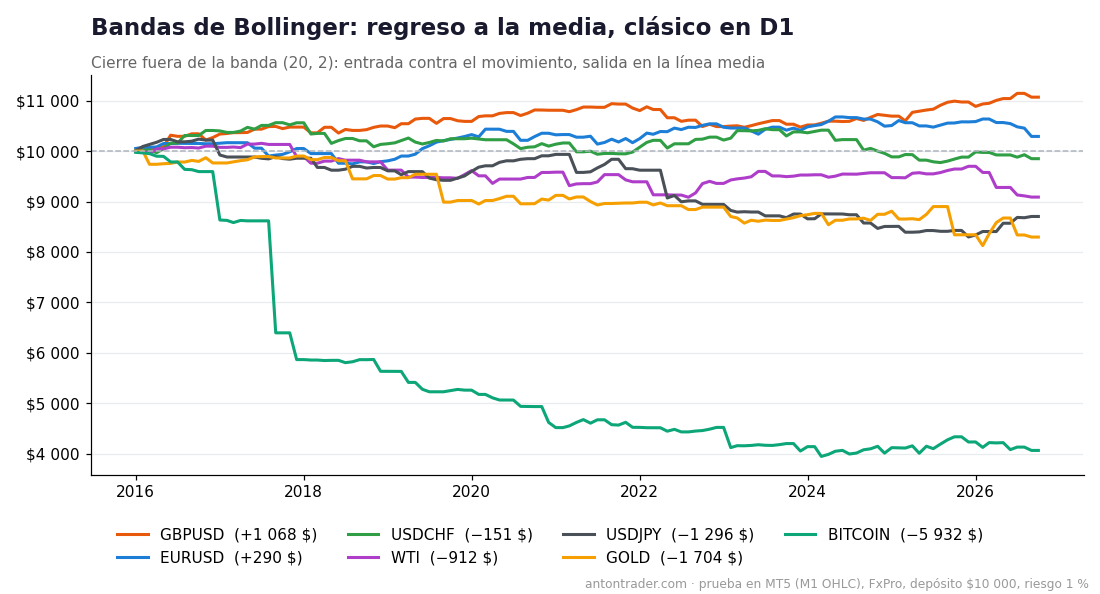
| Instrument (D1) | 10-year result | Profit factor | Max drawdown | Winning trades | Swaps |
|---|---|---|---|---|---|
| GBPUSD | +$1,068 | 1.51 | 6.3% | 66% | −$233 |
| EURUSD | +$290 | 1.12 | 5.5% | 61% | −$338 |
| USDCHF | −$151 | 0.95 | 8.8% | 62% | −$484 |
| WTI (oil) | −$912 | 0.70 | 13.3% | 57% | −$1,212 |
| USDJPY | −$1,296 | 0.64 | 19.6% | 60% | −$795 |
| GOLD | −$1,704 | 0.60 | 28.4% | 63% | −$444 |
| BITCOIN | −$5,932 | 0.28 | 61.8% | 57% | −$776 |
Look at the winning trades column: about 60% across the board. That’s how the strategy gets sold: you win more often than you lose. But on bitcoin, with 57% winning trades, the deposit lost almost 60%. Why?
- The trend doesn’t return to the mean. When bitcoin or gold enter a strong trend, a close outside the band is not “overbought,” but the start of the move. The position against the trend hangs for weeks and then closes with a huge loss that eats dozens of small wins.
- Swaps on commodities. On oil, 10 years of swaps took $1,212, more than the final loss.
- Where there are no strong trends, there is an opportunity. In these years, the pound and the euro against the dollar returned to the mean more often than they left in long trends. There, mean reversion does win.
An important detail: even on GBPUSD it is +$1,068 over 10 years on $10,000, that is, about 1% a year with 1% risk. The edge exists, but it is thin.
Block 2. Optimization on 2016–2022
I optimized on GBPUSD, on D1 and H4, and for comparison also on EURUSD H4. I tuned the period and width of the bands, a trend filter (SMA from 50 to 300 bars or no filter), whether sells are allowed, and an emergency stop in ATR.
- GBPUSD D1: of 143 sets, 83 were profitable in training and of those 54 stayed positive in the forward test.
- GBPUSD H4: 62 profitable in training; in the forward test only 19 survived.
- EURUSD H4: 42 profitable in training; in the forward test, 21.
Conclusion: for this strategy the daily chart is more reliable than the four-hour chart. I didn’t pick the most profitable set, but one from a “cluster” of neighboring variants that are all positive, both in training and in the forward test:
| Parameter | Classic | Optimization (GBPUSD D1) |
|---|---|---|
| Band period | 20 | 10 |
| Band width | 2 deviations | 1.5 deviations |
| Trend filter | none | only above the SMA 150 |
| Direction | buys and sells | buys only |
| Stop | none | 2 ATR |
Block 3. Forward test 2023–2026
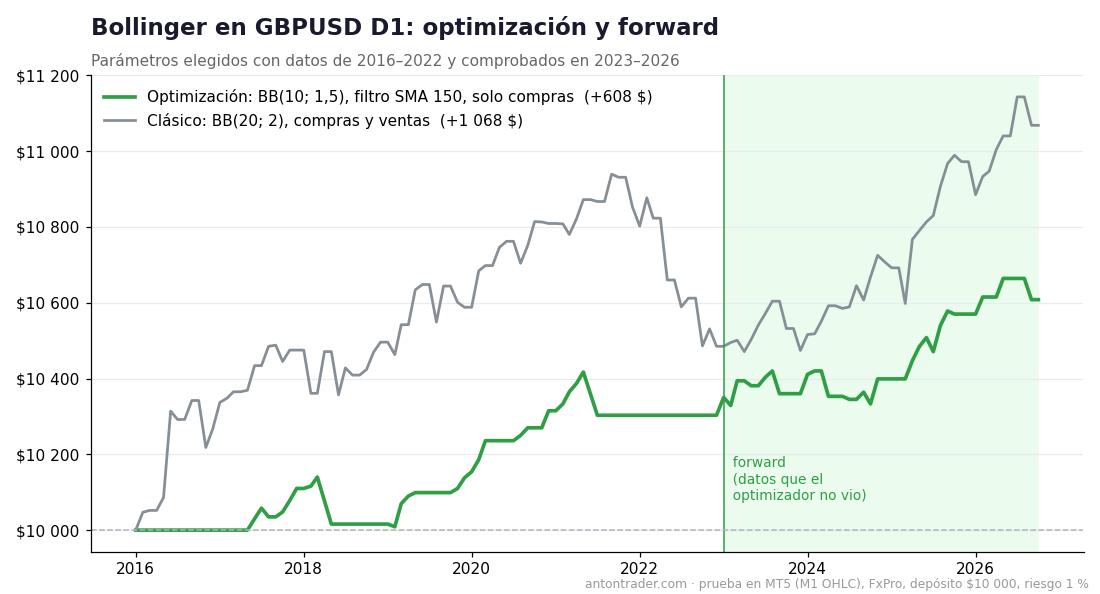
| Variant | Period | Result | Profit factor | Max drawdown | Trades |
|---|---|---|---|---|---|
| Classic | 2016–2022 | +$485 | 1.32 | 6.3% | 73 |
| Optimization | 2016–2022 | +$303 | 1.81 | 1.7% | 34 |
| Classic | 2023–2026 (forward) | +$488 | 1.84 | 2.1% | 43 |
| Optimization | 2023–2026 (forward) | +$288 | 1.59 | 1.8% | 40 |
Each period was tested separately, starting with $10,000. And here is the honest result you almost never see in robot reviews:
- Both versions passed the forward test. Both the classic and the optimization made money in 2023–2026 with a profit factor above 1.5.
- In the forward test, the classic did better than the optimization. +$488 versus +$288. The optimizer fit itself to 2016–2022 and added no profit on new data.
- But the optimization cut the drawdown. Over the whole period, 1.8% versus 6.3% for the classic. The trend filter and the ban on sells eliminated the most painful trades against the move.
Of the 83 sets that were profitable in the training period, 54 stayed positive in the forward test: about two thirds. On the pound, the strategy has a stable edge, not a lucky number.
The risks, no makeup
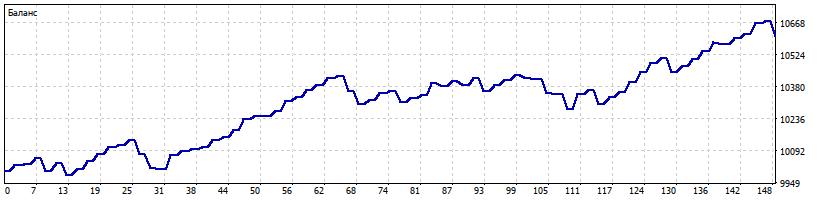
- Small returns. With 1% risk it’s about +$60–100 a year on $10,000. This is not a robot for growing your account fast: it is a proven edge, but a thin one.
- A single big trend can wipe out years. The classic has no stop. Look at bitcoin and gold in the table above: that’s what mean reversion looks like in a trending market.
- It works in very few places. In my tests, only on GBPUSD and, weakly, on EURUSD. It’s not worth launching it on other instruments “to see what happens.”
- Optimizing doesn’t always improve the result. In the forward test, the classic made more. The optimized .set in the file is for those who prefer a low drawdown over maximum profit.
Where to run the robot
The robot works in MetaTrader 5 with any broker that offers the GBPUSD pair. My test was done at FxPro. The other brokers in my ranking also work: RoboForex and Tickmill. On the daily chart the spread barely affects the result, but it is worth comparing the swaps on long positions.
Download the free “Bollinger” robot
The robot is free for clients of the brokers in my ranking:
- Open a MetaTrader 5 account with one of the brokers above (or use the one you already have).
- Go to the Telegram bot with the button and send your account number.
- After verification, the bot sends you the file: the robot, the classic Bollinger parameters (20, 2) and those optimized for GBPUSD D1, plus the instructions.
📊 Download the free robot on Telegram
My conclusion
“Buy at the lower band, sell at the upper” is a rule that burns deposits in trending markets. On bitcoin, gold, oil and the yen it only lost over 10 years. The high percentage of winning trades here is a trap: it looks pretty on the report right up to the day the market doesn’t return to the mean.
But on the pound the strategy is positive both before 2023 and after: it passes the test of the future, both as the classic and after optimization. No miracles: the return is small, but so is the drawdown. And it’s a good lesson: a robot that wins modestly in a single market is more honest than a “grail” that promises everything everywhere.
Other analyses: the 50/200 “golden cross”, a trend system that works exactly where Bollinger sinks, on bitcoin. The short system Connors RSI-2, with similar logic, also passed the forward test on the pound, and the Turtles, on bitcoin.
Backtest results do not guarantee future results.
Sources
- John Bollinger — “Bollinger on Bollinger Bands,” 2001.
- My own tests in MetaTrader 5 on the FxPro demo server, October 2026.
Where to trade
These are the brokers and exchanges I use that work with clients from Latin America. Always check that the service is available in your country and start small.
Risk warning: CFDs, Forex and crypto derivatives carry a high risk of losing money due to leverage. This article is not investment advice.