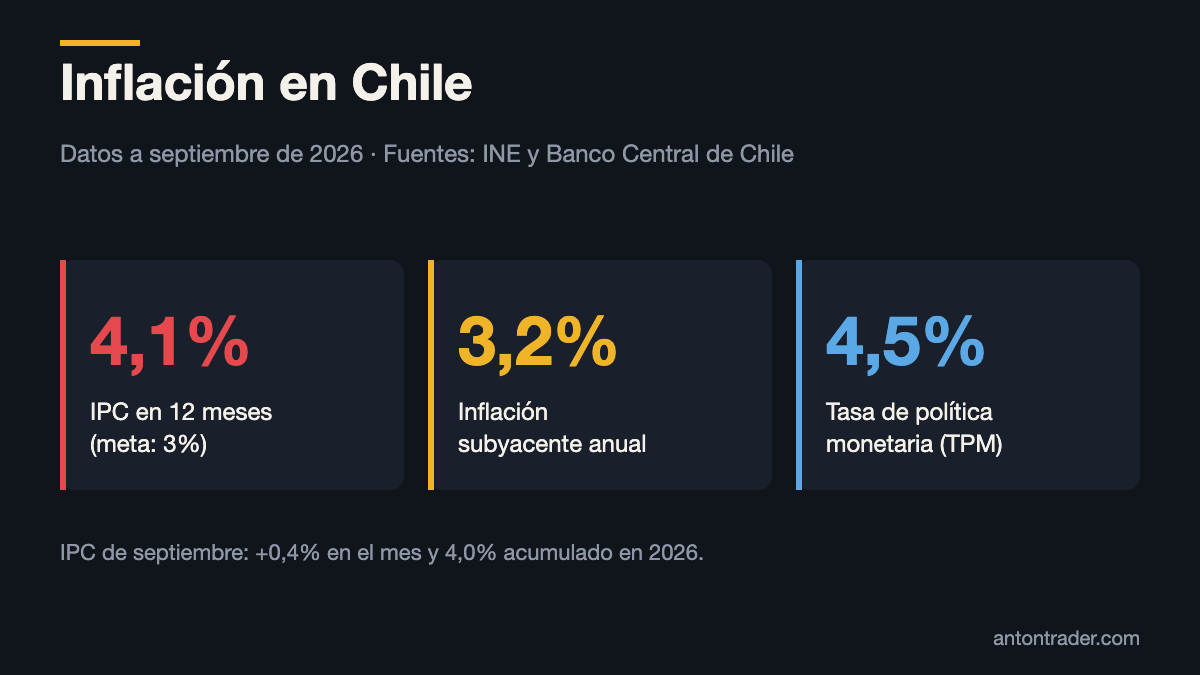
The inflation in Chile reached 4.1% over 12 months in September 2026, according to the INE, and the Central Bank decided to keep its rate at 4.5%. But the bank’s message was clear: inflation risks have increased significantly. I’ll explain why and what it means for your pesos.
September CPI
Prices rose 0.4% in the month, somewhat less than the market expected (0.5%) and less than in August (0.6%). So far in 2026 the CPI has accumulated 4.0%, and over 12 months, 4.1%. The Central Bank’s target is 3%.
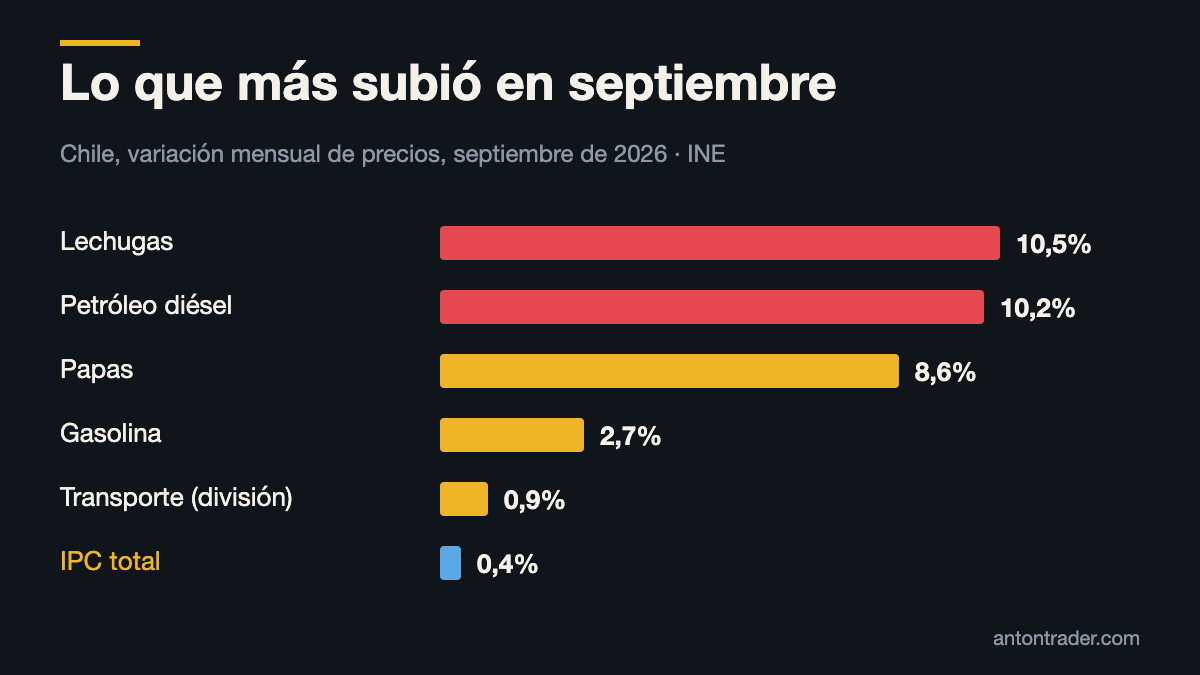
The biggest increases were in fresh food and fuel. Lettuce rose 10.5%, potatoes 8.6%, diesel 10.2% and gasoline 2.7%. On the other side, the insurance and financial services category fell 5.9%, which kept the overall number from being worse.
The Central Bank holds the rate, but warns
On October 27, the Central Bank Board left the monetary policy rate (TPM) at 4.5%, unanimously. The decision itself was no surprise; the tone was. The bank said that risks to inflation have increased significantly and that projections for the coming months are above what it expected in its September Monetary Policy Report.
The reasons:
- More expensive oil: because of tensions in the Middle East, crude is about 25% above the level it had in the September report. Chile imports almost all of its fuel, so this shows up quickly in gasoline and transportation costs.
- El Niño: an unusually strong phenomenon that is putting pressure on food prices.
- Tighter financial conditions: the IPSA fell, the peso depreciated and long-term rates rose.
At the same time, the economy cooled: the August Imacec fell 1.0% year over year, mostly because of mining. Excluding mining, it grew 1.4%. It’s the classic central bank dilemma: rising prices and a slowing economy.
| Indicator | Figure |
|---|---|
| CPI September 2026 (monthly) | 0.4% |
| CPI over 12 months | 4.1% |
| Core inflation, annual | 3.2% |
| 2-year expectations | 3.0% (EEE) and 3.2% (EOF) |
| TPM | 4.5% |
| Next meeting | December 15, 2026 |
Sources: INE and Central Bank of Chile.
What it means for your wallet
Some good news: core inflation, which excludes the most volatile prices, is at 3.2%, close to the target. That indicates that, for now, the problem comes from external shocks (oil and weather) and not from inflation that has become entrenched across the whole economy. Two-year expectations also remain close to 3%.
The bad news: if oil stays expensive and the peso stays weak, those shocks could gradually pass through to the rest of prices. That’s why the Central Bank says it will monitor “the transmission or persistence” of these shocks.
- If you save in pesos: with the TPM at 4.5% and inflation at 4.1%, the real rate is almost nonexistent. A term deposit barely protects your purchasing power.
- If you follow the dollar: USD/CLP is very sensitive to the price of copper, oil and the interest rate differential with the United States. In times of global tension, the Chilean peso tends to weaken.
- Diversify wisely: keep part in a strong currency, another part in assets like gold, and never everything on a single platform.
If you want to learn to trade currencies like USD/CLP or gold, start on a demo account and with a small risk per trade. I work with FxPro, RoboForex and Tickmill for Forex and CFDs, and with Bybit or BingX to buy crypto.
Where to trade
These are the brokers and exchanges I use that work with clients from Latin America. Always check that the service is available in your country and start small.
Risk warning: CFDs, Forex and crypto derivatives carry a high risk of losing money due to leverage. This article is not investment advice.