Inflation in Mexico picked up in the first half of October 2026: prices rose 0.41% in two weeks and the annual rate came in at 3.62%, according to INEGI. The jump came mostly from electricity and some food items. I’ll tell you what happened and what Banxico might do.
The numbers for the half-month
A 0.41% increase in a half-month is quite a lot: in the same period of 2025 the increase was 0.28%. Even so, annual inflation (3.62%) ended up practically the same as a year ago (3.63%) and within Banxico’s range, whose target is 3% with a margin of one point above or below.
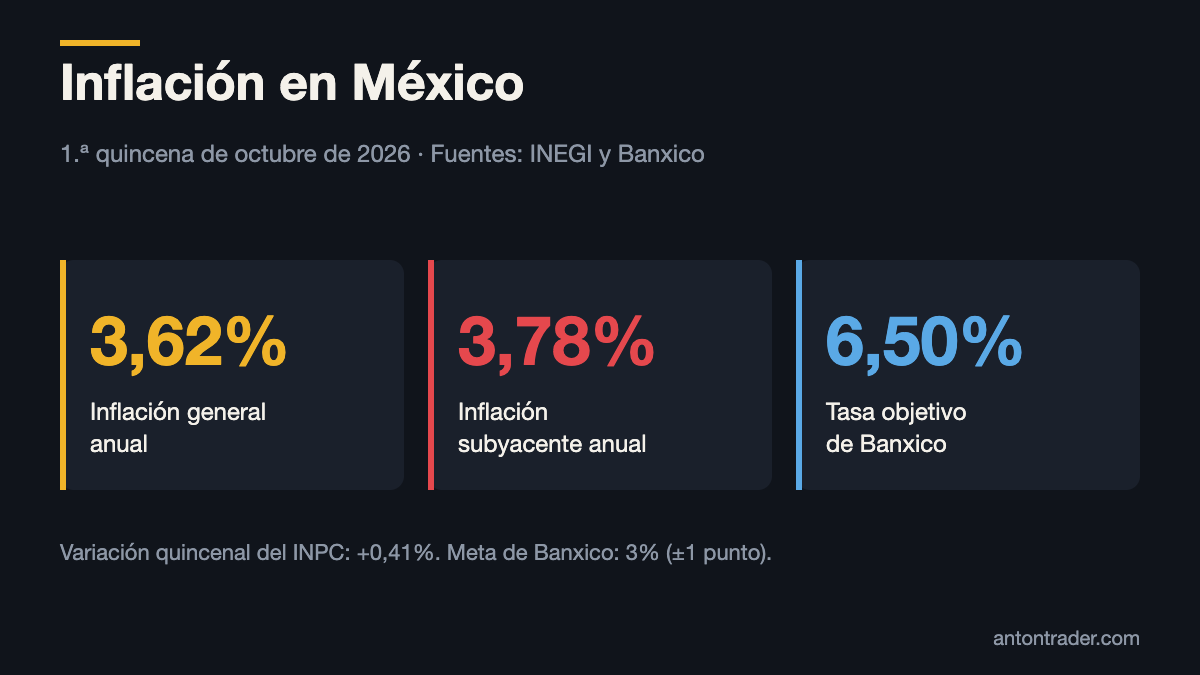
The figure the central bank watches most closely is core inflation, which strips out more volatile prices such as fresh food and energy. It stands at 3.78% annually, above the headline rate. Within it, services are up 4.26% and goods 3.28%. In other words: services (restaurants, insurance, education) continue to get more expensive faster than products.
Electricity and tomatoes, the culprits
Electricity rose 18.51% in the half-month. It’s not that the CFE suddenly changed its rates: summer subsidies ended in 18 cities, as happens every year at this time. Tomatillos (+22.07%), zucchini (+16.27%) and air transportation (+14.77%) also hit hard.
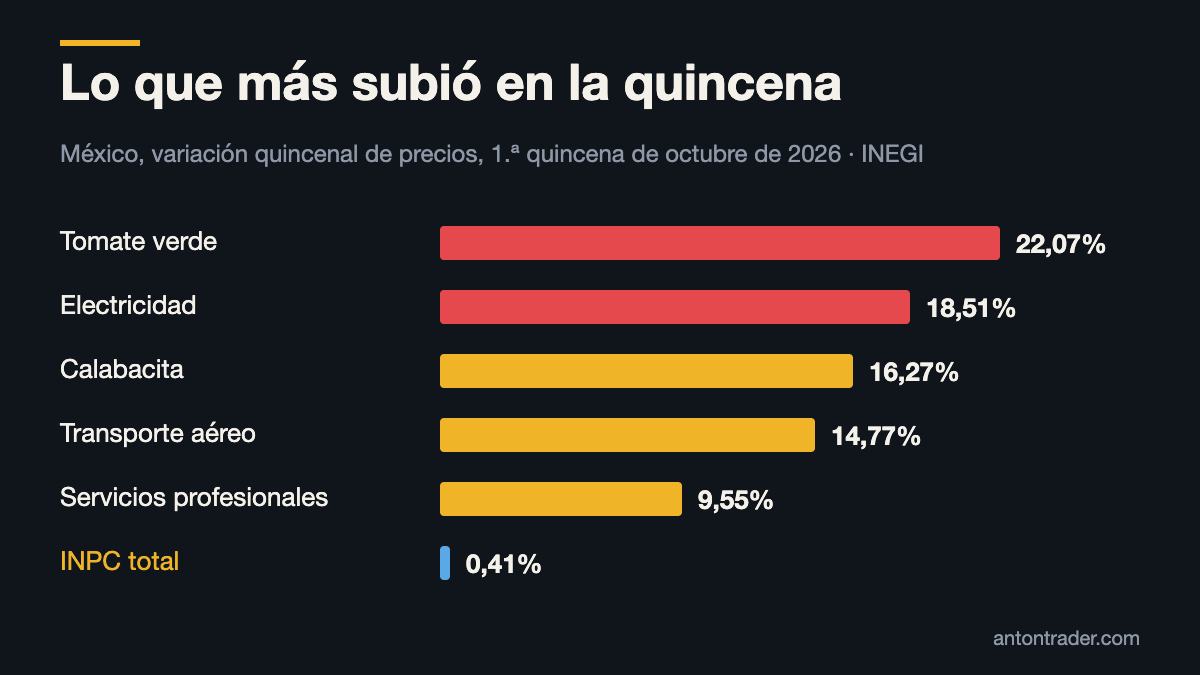
On the other side, lime (−10.43%), avocado (−4.79%), orange (−4.58%) and banana (−4.15%) went down. Over 12 months, agricultural products are even 1.90% cheaper.
| Indicator | Half-month | Annual |
|---|---|---|
| Headline inflation | 0.41% | 3.62% |
| Core | 0.25% | 3.78% |
| Non-core | 0.98% | 3.08% |
| Minimum consumption basket | 0.40% | 3.44% |
Source: INEGI, first half of October 2026.
What will Banxico do?
On September 24, Banxico left its rate at 6.50% for the third time in a row, unanimously. The interesting part is the context: a week earlier, the US Federal Reserve had raised its rate by a quarter point, to a range of 3.75%–4.00%. Banxico made it clear that it will not follow the Fed “mechanically,” because the Mexican economy is in a different situation.
The bank sees upside risks to inflation: core inflation that won’t come down, trade policy, geopolitical conflicts and a possible depreciation of the peso. It expects headline inflation to reach the 3% target only in the fourth quarter of 2027. Analysts expect the rate to stay at 6.50% for the rest of 2026, although some don’t rule out a hike if the Fed keeps tightening.
What it means for your wallet and for the peso
- Savings in pesos: with the rate at 6.50% and inflation at 3.62%, the real return on a good peso instrument is around 2.8% per year. Positive, but much less attractive than two years ago.
- The differential with the Fed has narrowed: the gap between Banxico’s rate and the Fed’s rate is what made the peso attractive to investors. If it keeps shrinking, USD/MXN becomes more sensitive to any bad news. I explained this in 3 factors that can move USD/MXN.
- November expenses: electricity without the summer subsidy and El Buen Fin can hit your budget. Plan before you spend.
If you want to diversify part of your savings outside the peso or learn to trade USD/MXN, start on a demo account and with little money. For Forex and gold I work with FxPro, RoboForex and Tickmill; for crypto and stablecoins, with Bybit and BingX.
Where to trade
These are the brokers and exchanges I use that work with clients from Latin America. Always check that the service is available in your country and start small.
Risk warning: CFDs, Forex and crypto derivatives carry a high risk of losing money due to leverage. This article is not investment advice.