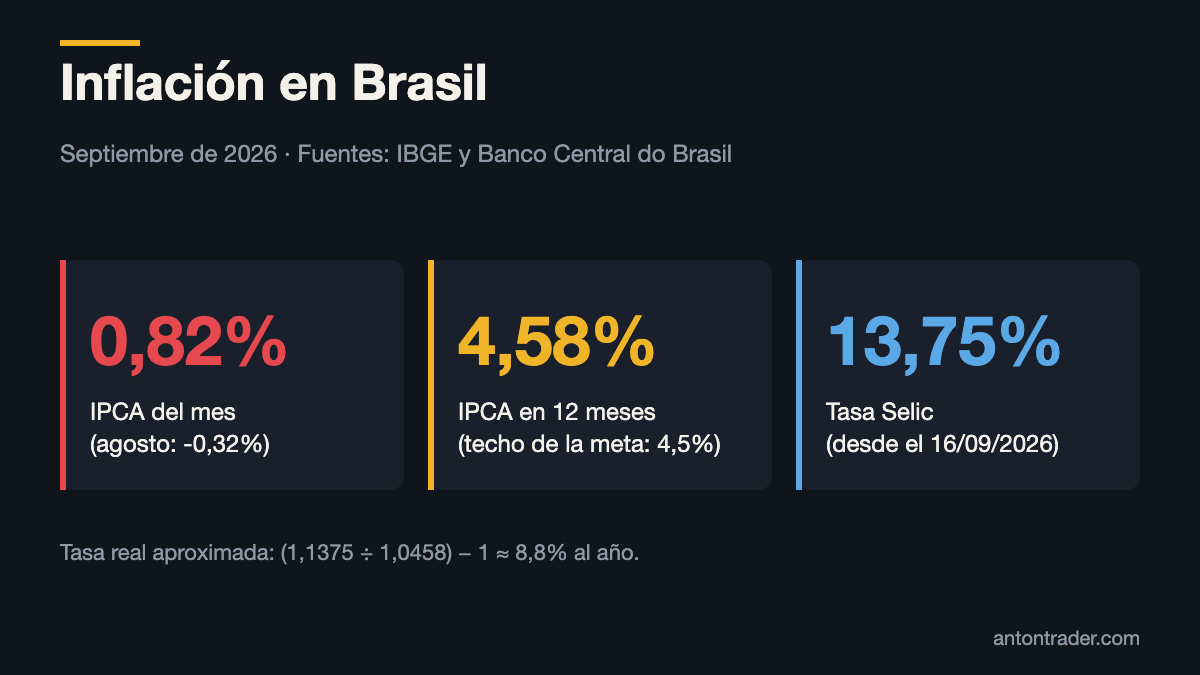
Inflation in Brazil jumped in September: the IPCA rose 0.82% in the month and reached 4.58% over 12 months, above the ceiling of the target range. At the same time, the Central Bank keeps cutting the Selic, which is now at 13.75%. Let’s look at what happened and why it matters outside Brazil too.
A Rebound We Saw Coming
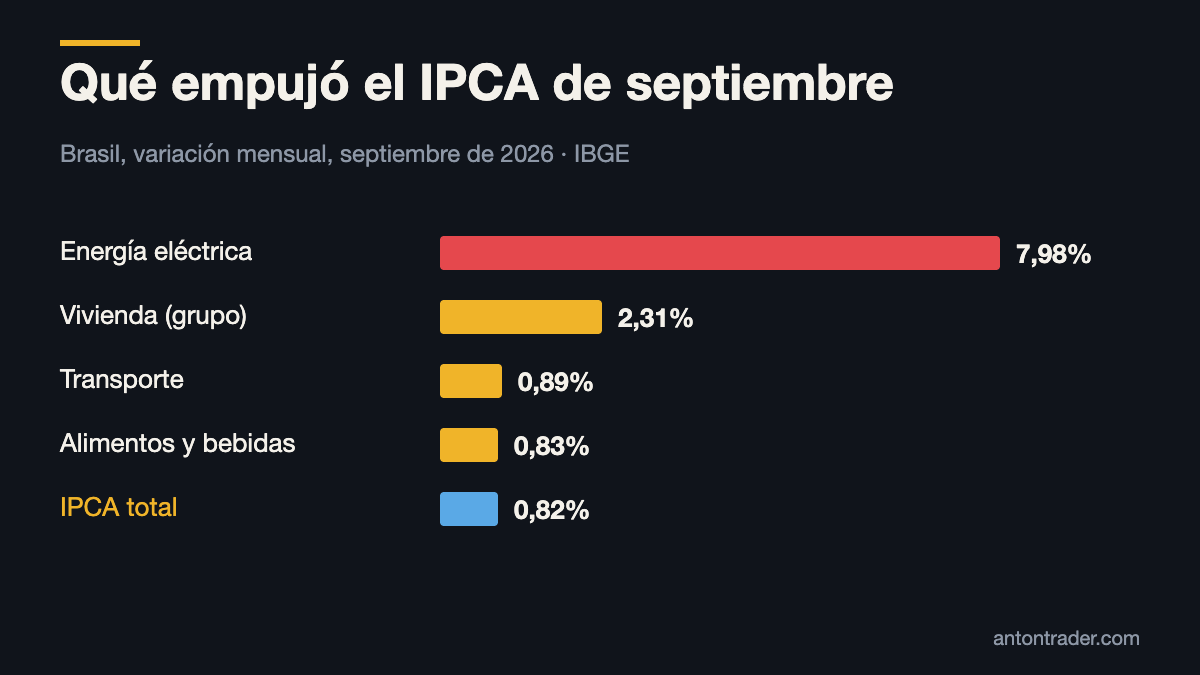
According to the IBGE, prices fell 0.32% in August, the lowest reading in four years. But that drop had a catch: a bonus from the Itaipú dam that was credited to electricity bills in August. In September the bonus disappeared and residential electricity rose 7.98%. On its own, it contributed 0.32 points of the month’s 0.82.
In addition, the yellow tariff flag remained in effect, which makes electricity more expensive. And it wasn’t just energy: all groups in the index rose. Airfares increased 9.66%, tomatoes 37.76% and potatoes 24.07%.
| Indicator | Value |
|---|---|
| IPCA September 2026 | 0.82% |
| IPCA year-to-date 2026 | 3.95% |
| IPCA over 12 months | 4.58% |
| Inflation target | 3% (range of 1.5% to 4.5%) |
| Selic rate | 13.75% |
Sources: IBGE and Banco Central do Brasil.
The Selic: Falling, but Still Very High
The Monetary Policy Committee (Copom) kept the Selic at 15% from June 2025 through March 2026. In April it began cutting, and on September 16 it made its fifth consecutive cut, of 0.25 points, to 13.75%.
What matters is the real rate, that is, the rate minus inflation. With a Selic of 13.75% and inflation of 4.58%, the real rate is around 8.8% per year. It’s one of the highest in the world. That’s why the real attracts investors looking for yield, and why every Copom decision moves USD/BRL.
The next Copom decision is on November 4. In the Focus survey of October 26, the market expected the Selic to end 2026 at 13.25%, in other words, with more cuts. The problem is that inflation is already above the ceiling of the target range and the Central Bank warned that El Niño could push food prices up in the coming months. If the IPCA keeps rising, the room to cut rates shrinks.
What It Means for Your Wallet
- If you live in Brazil: fixed income in reais still pays well above inflation. It’s one of the few countries in the region where saving in local currency makes real sense, as long as the rate stays this high.
- If you follow the forex market: the combination of “inflation up, Selic falling” is exactly the one that creates volatility in the real. An IPCA reading higher than expected or a tougher Copom can move the pair sharply. The next IPCA comes out on November 10.
- If you’re interested in the rate differential: I explained it in how the differential with the Fed moves the peso, the real and the sol. Brazil is the classic example.
Trading the real around news is not for beginners: the spread widens and the price can jump. If you want to try, do it on a demo first and with a defined stop. For Forex and CFDs on currencies I work with FxPro, RoboForex and Tickmill.
Where to Trade
These are the brokers and exchanges I use that work with clients from Latin America. Always check that the service is available in your country and start small.
Risk warning: CFDs, Forex and crypto derivatives carry a high risk of losing money due to leverage. This article is not investment advice.