Trading scams in Latin America almost never start with a well-known broker. They start with a message: someone who “makes a lot of money” and offers to trade for you. And once you’ve lost your money, the second scam shows up: the person who promises to recover it. I’ll explain how both work so you don’t fall for them.
The “Account Manager” Scam
The scheme is almost the same in every country. A profile full of cars, trips and screenshots of profits messages you on Instagram, WhatsApp or Telegram. He suggests that you send him money “to trade,” or that you open an account on a platform he points you to.
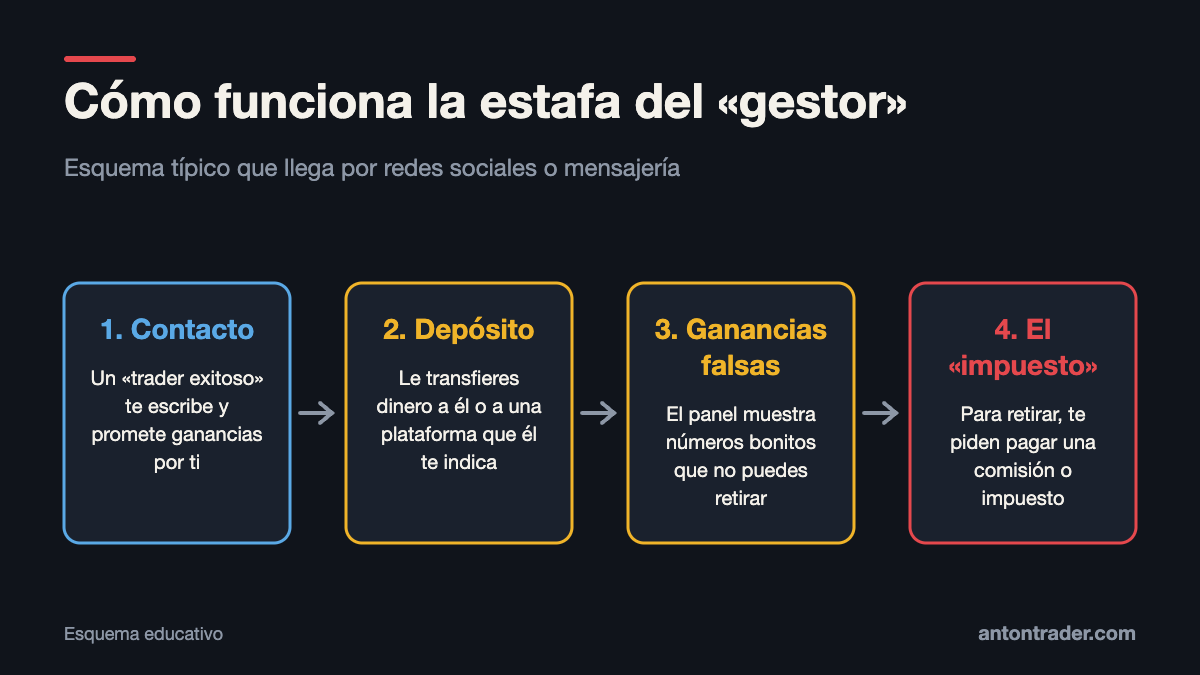
At first everything looks good: the dashboard shows profits. But when you ask to withdraw, the obstacles appear: a “tax,” a “release fee,” a “verification deposit.” Every payment brings you closer to the same ending: the money never comes out.
Another variant I keep seeing: the platform simply blocks your access. Yesterday you logged in and traded; today your password doesn’t work, the codes don’t arrive and there’s no notice at all. It looks like a lost password, but you won’t be able to recover it.
The Second Scam: The Fund “Recovery Agent”
After losing money, many people look for help on the internet. That’s where the sites that “expose” scams and sell fund recovery services with lawyers are waiting.
My position is clear: if criminals scammed you, no lawyer is going to get that money back for you. A lawyer can help you in a dispute with a real company, which plays by the rules. Scammers don’t play by the rules. Money stolen by scammers is only recovered when the police catch them, and even then it happens very rarely.
The typical scheme: they tell you they only charge a percentage of what is recovered, then ask you for money for “paperwork” and “documents,” they get nothing back, and the contract states that they sold you “consulting.” If someone offers to recover money from scammers, distrust that person.
Red Flags
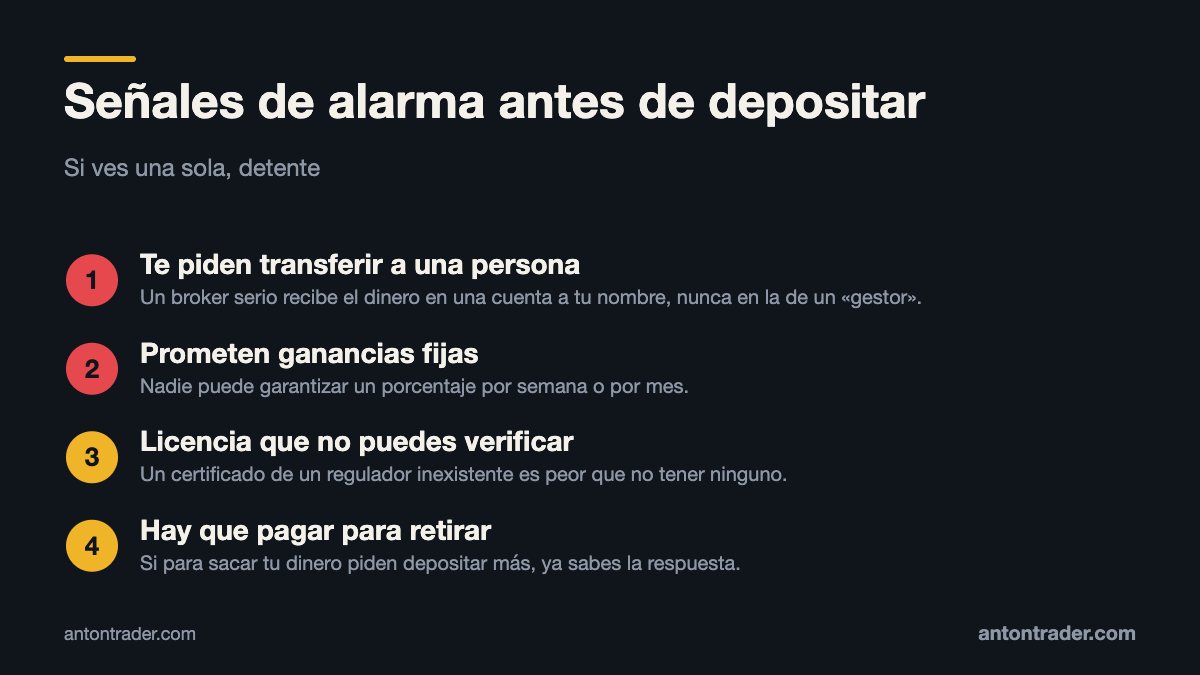
- Depositing into someone’s personal account. With a real broker or exchange, the money goes to your own account, and the withdrawal comes back by the same method.
- Guaranteed profits. In the markets, nobody can promise a fixed return.
- Dubious licenses. Check on the regulator’s website that the company exists. A certificate from a made-up regulator is a bad sign, worse than having no license.
- Pressure and urgency. “Today only,” “last spots,” “if you don’t pay now you lose everything.”
How to Protect Yourself
The most useful rule I know: trade yourself, in your own account, with a large company that has many years in the market. A company with many clients earns more by treating you well so that you keep trading than by keeping your deposit.
Before you deposit for real, make a small test deposit and withdrawal. If the money doesn’t come out easily, there’s no second chance. More criteria in how to choose a reliable broker and in the criteria I use to rule out a broker.
If you want to get started, do it with brokers with a track record such as FxPro or RoboForex, or with large exchanges such as Bybit and BingX, always in your own name and with amounts you can afford to lose.
Where to Trade
These are the brokers and exchanges I use and that work with clients from Latin America. Always check that the service is available in your country and start small.
Risk warning: CFDs, Forex and crypto derivatives carry a high risk of losing money due to leverage. This article is not investment advice.