When someone in Latin America starts with crypto, they almost always buy spot: Bitcoin, Ethereum, or USDT, and hold it. Then they discover futures, see that they can also profit when the price falls, and that with little money they can move large positions. That’s where both the opportunities and the problems begin.
Spot: you buy the coin
- You own the asset and can withdraw it to your wallet.
- You only profit if the price goes up.
- There is no liquidation: if the price drops 50%, you lose on paper, but you still have your coins.
Futures: you trade the price
- You don’t buy the coin: you open a contract, normally with margin in USDT.
- You can profit from rises (long) and from drops (short).
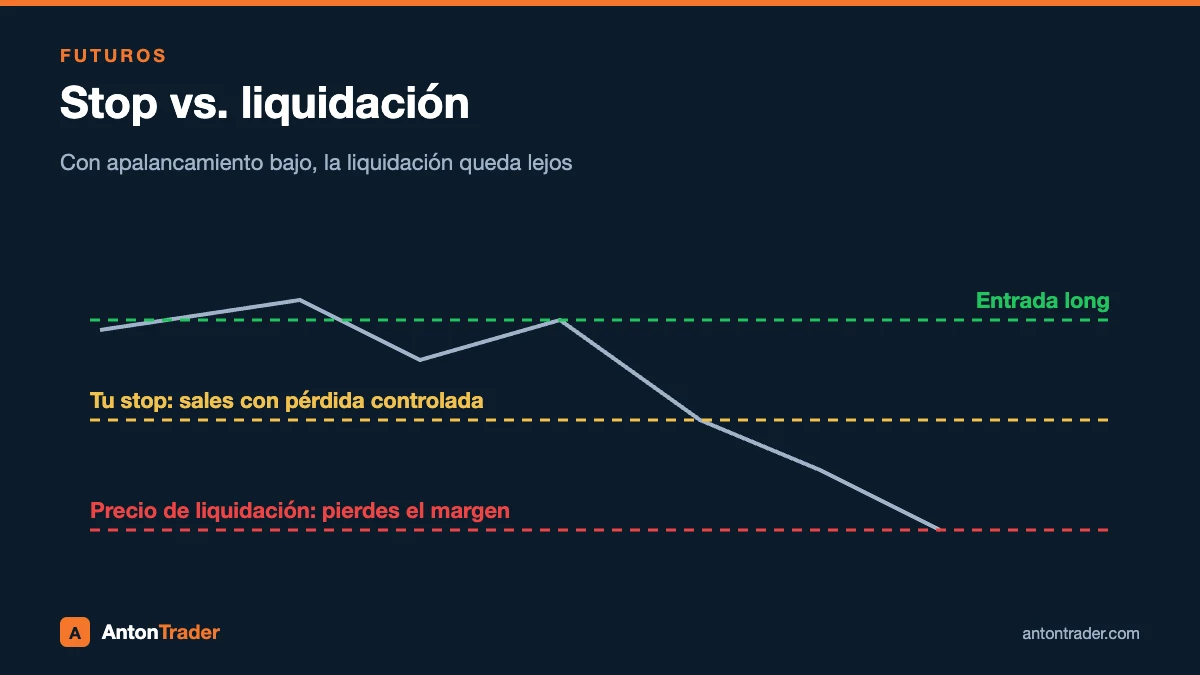
- There is leverage and a liquidation price: if the market moves against you far enough, the exchange closes your position and you lose your margin.
- There is a funding rate, which is paid or received every few hours.
When I use each one
For long-term investing I prefer spot, without leverage. In my TITÁN strategy I split the capital: most of it in long-term positions and a smaller part for intraday trading.
For trading I use futures, because they let me trade both directions and work with precise stops. But with rules:
- Low leverage. Position size comes from calculated risk, not from impulse.
- With or without a stop, the liquidation price has to be very far away. Sometimes I set a stop; other times I trade without one, but with such a small volume that I can afford to wait.
- Liquid coins: the top 30 by market capitalization, not unknown tokens.
In the lesson What to trade: Forex or crypto futures? I compare both markets in more detail.
Where to trade
These are the brokers and exchanges I use that work with clients from Latin America. Always check that the service is available in your country and start small.
Risk warning: CFDs, Forex, and crypto derivatives carry a high risk of losing money due to leverage. This article is not investment advice.