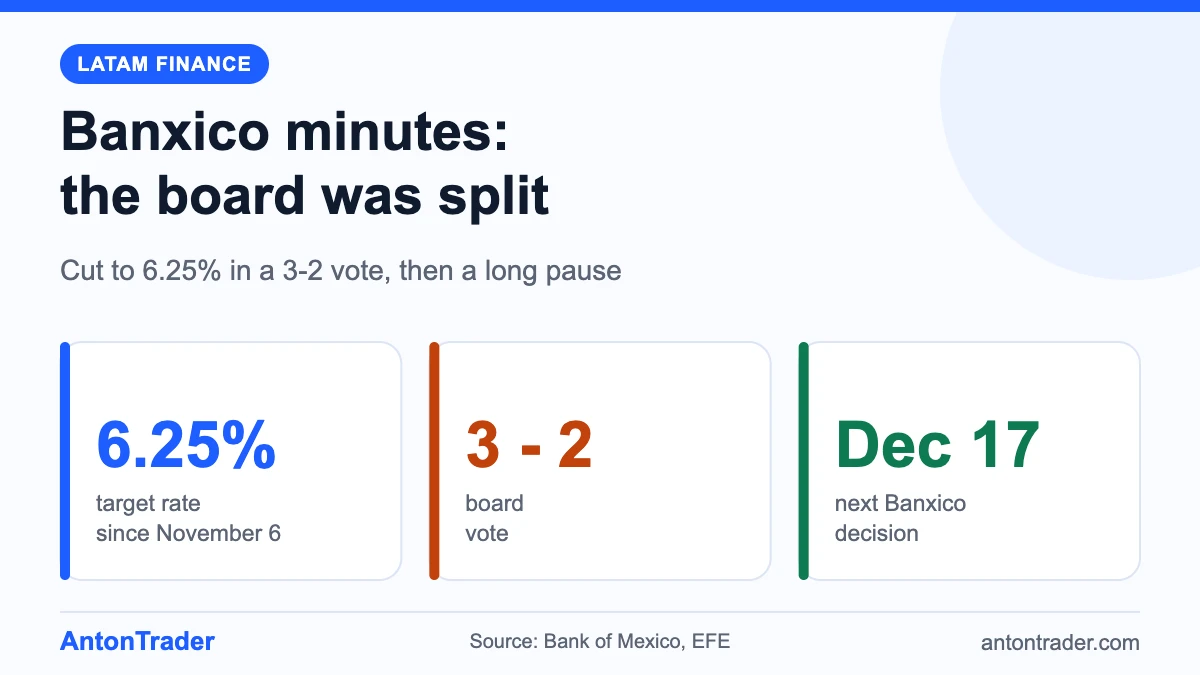
The Banxico minutes confirmed what the market suspected: the rate cut to 6.25% on November 5 passed by a single vote. The Board voted 3-2, and the main topic of discussion was the peso. Now the Bank of Mexico expects to hold the rate at 6.25% “for an extended period.”
Who voted for what
The minutes, published on November 19, show a Board split in two:
- In favor of the cut (3 votes): Governor Victoria Rodríguez Ceja and Deputy Governors José Gabriel Cuadra and Omar Mejía. Their argument: the economy is still operating below its capacity and the restrictive policy is still having an effect.
- For holding at 6.50% (2 votes): Deputy Governors Galia Borja and Jonathan Heath.
Borja explained her concern clearly. When the rate differential between Mexico and other countries narrows, investors can use the peso to hedge positions in other assets. That exposes it more to global swings, raises volatility and can delay inflation reaching the 3% target.
The peso, at the center of the discussion
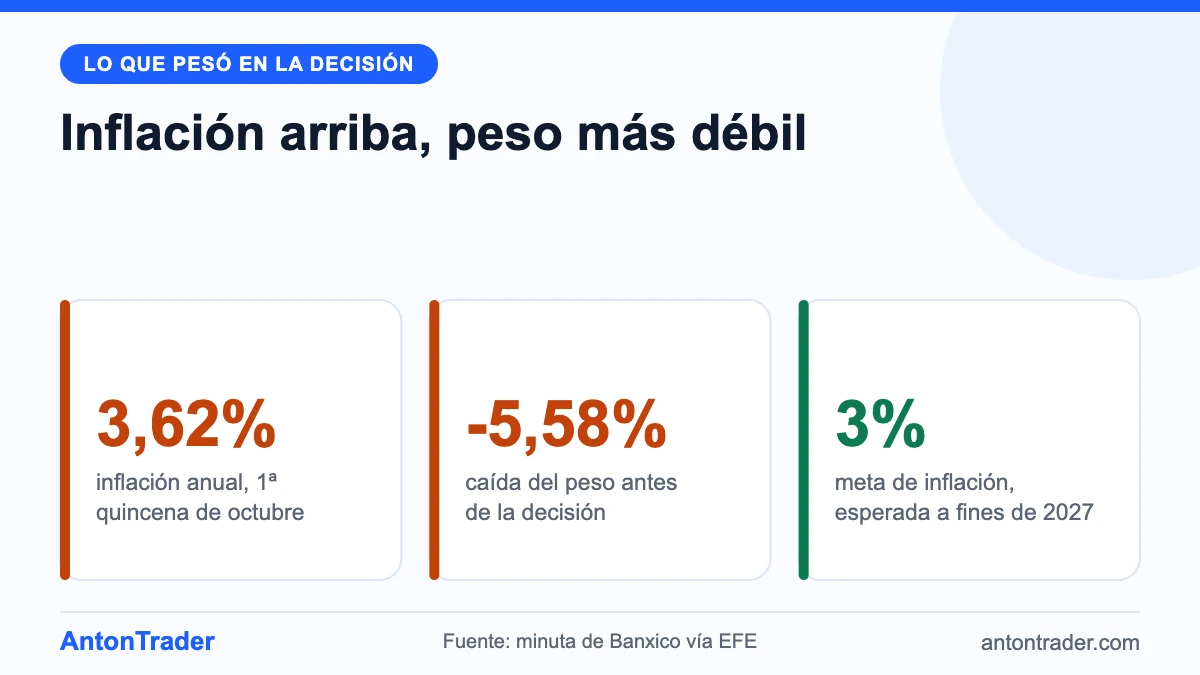
According to the minutes, the risk that a weaker peso would push prices higher is what divided the Board. Before the decision, the peso had depreciated 5.58%. And headline inflation had risen from 3.42% to 3.62% between the first half of September and the first half of October.
The majority bet that weak demand will slow the pass-through of the exchange rate to prices. That is why it described the cut as a “one-off adjustment.” Banxico still expects inflation to reach 3% only in the fourth quarter of 2027.
The cut was a surprise: the consensus expected the rate to stay at 6.50% in November and through the end of the year. According to the minutes, derivatives were barely pricing in a rate of 6.34% for December.
Five points down from the peak
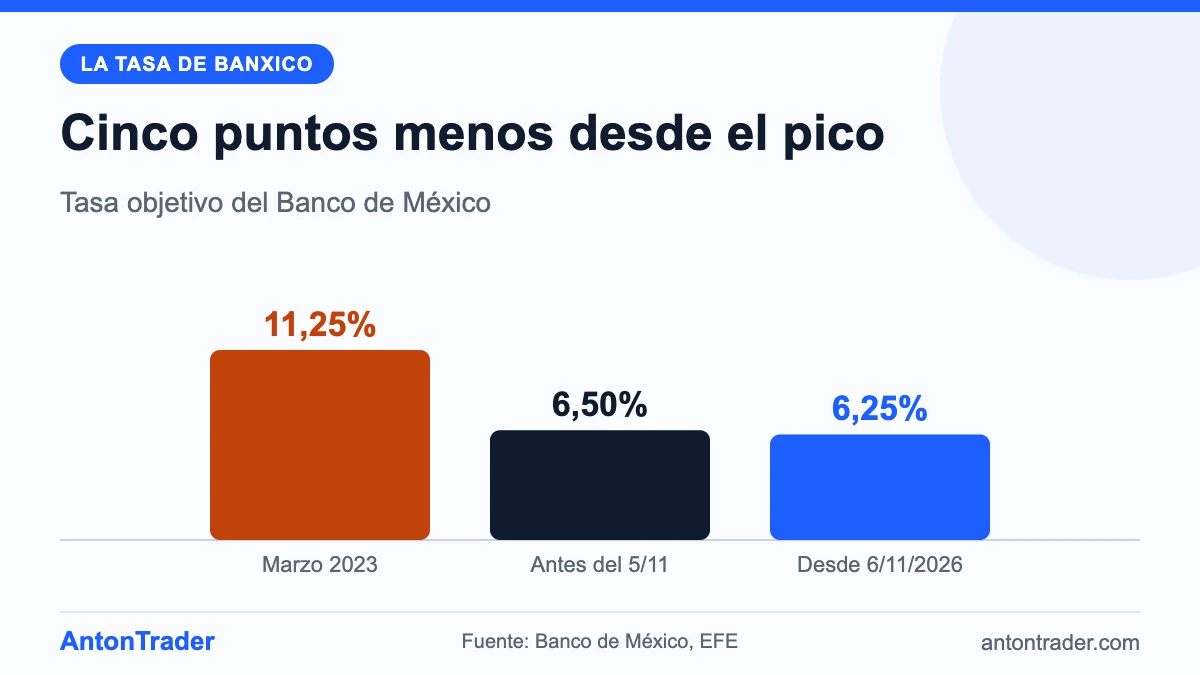
With this move, the rate has already fallen five points from its peak of 11.25% in March 2023. The cutting cycle is reaching a pause: the next decision, the last of 2026, will be on December 17.
What I see here is a signal of a change of stage. A Board split 3-2 that also promises a long pause says that the room to keep cutting has run out. From now on, the peso will depend more on what the Federal Reserve does and on global risk appetite than on Banxico.
What it means for you
- Loans: don’t expect credit card, auto or mortgage rates to fall much further in the coming months.
- Peso savings: CETES and promissory notes still pay positive real rates with inflation at 3.6%, but the premium is shrinking.
- A more sensitive peso: with a smaller rate differential, the exchange rate can move more with news from abroad. If you have to pay something in dollars, don’t leave it for the last day.
- Date to mark: December 17, the last decision of the year.
If you want to trade USDMXN or gold with a dollar account, I use brokers with years of track record such as FxPro, Tickmill and RoboForex. Start on a demo account and then with a small amount of money.
Sources
- Bank of Mexico: monetary policy announcement of November 5, 2026
- Infobae (EFE): Banxico’s Board is divided over the impact on the peso
- Latinus (EFE): the risk of a peso decline divided the meeting
Everything written is my personal opinion and experience, not investment advice. Trading leveraged CFDs, Forex and cryptocurrencies carries a high risk of losing money.