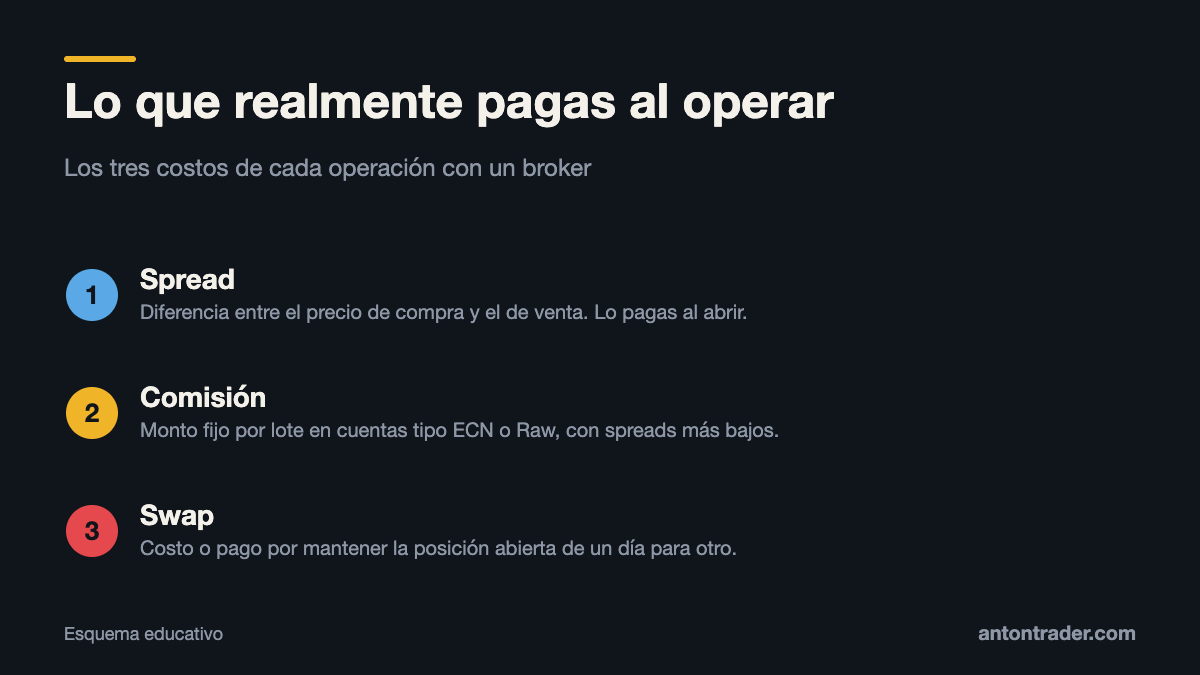
The spread in Forex is the first cost you pay on every trade, even though nobody sends you an invoice for it. Together with commission and swap, it decides how much you keep in the end. If you don’t understand it, you can get the market direction right and still lose money.
Spread: the cost you pay when you open
Every instrument has two prices: the buy price (ask) and the sell price (bid). The difference is the spread. If EUR/USD is quoted at 1.1000 / 1.1001, the spread is 1 pip.
Think of it like a currency exchange office: it sells you dollars a bit more expensive than it buys them from you. The moment you open the position you are already slightly in the red, and the price has to move in your favor by at least that distance for you to get back to zero.
The spread is not fixed. It widens during periods of low liquidity, at the market open on Monday, and during major news such as the US jobs report or a rate decision. This is normal: there are fewer orders and more risk for everyone. That’s why, in those minutes, an order can be executed at a worse price than you expected.
Commission: standard accounts and raw accounts
Many brokers offer two types of accounts:
- Standard: no commission, but a wider spread. The entire cost is built into the spread.
- ECN, Raw or similar: a very low spread, sometimes close to zero, plus a fixed commission per lot.
Which one is better? Add both costs together. If you make many short trades, as in scalping, every tenth of a pip counts and an account with commission usually turns out cheaper. If you make few trades and hold them for days, the difference matters less.
Swap: the cost of sleeping with your position open
If you leave a trade open past the daily close, the broker charges you or pays you a swap. It depends on the interest rate differential between the two currencies in the pair (I explain this in the article on the rate differential). In pairs with high-rate currencies, such as the Mexican peso, the swap can be large in one direction and negative in the other.
Watch out for Wednesdays: many brokers charge the triple swap that day to cover the weekend. And in crypto, holding positions has its own funding cost.
How to calculate what a trade costs you
In EUR/USD, 1 pip is worth about 10 dollars per standard lot. So, with a spread of 1 pip:
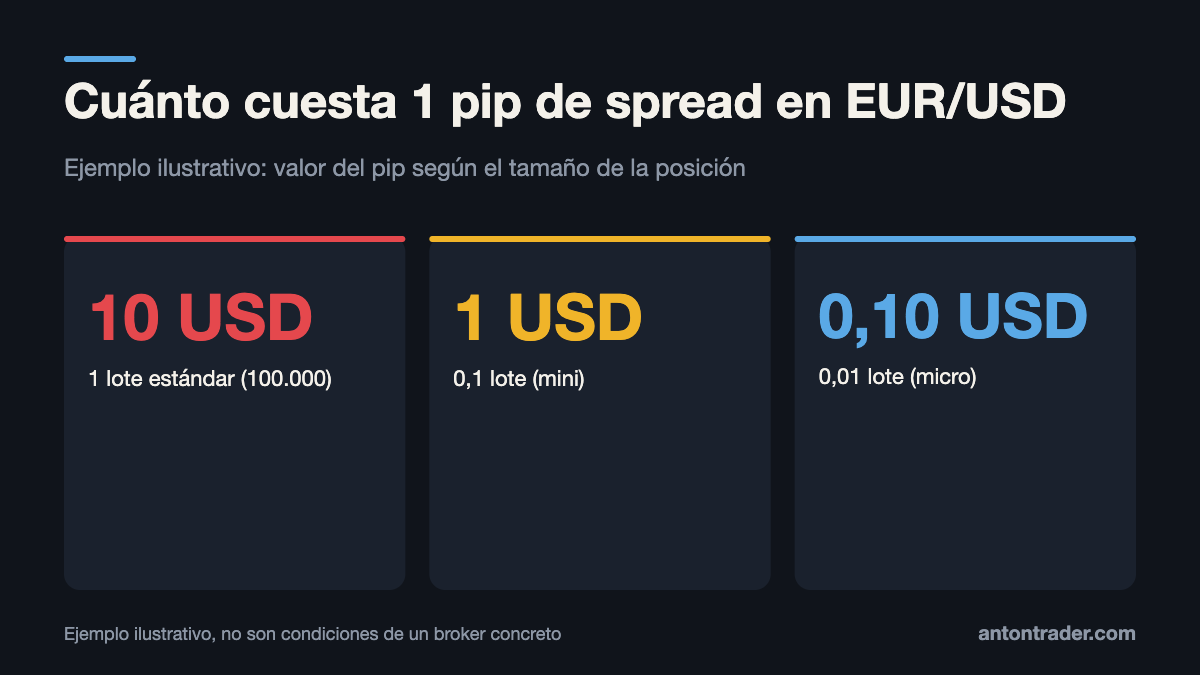
It seems small, but do the monthly math: 5 trades a day with 1 lot and a 1-pip spread come to 50 dollars a day in spread alone. That’s why with leverage the danger is not just the risk: with large lots, costs grow too.
Before opening an account, check the broker’s website for the table of typical spreads, the commission per lot and the swaps for the instrument you are going to trade. Brokers such as Tickmill, FxPro or RoboForex publish these conditions by account type. Compare with numbers, not with advertising.
Where to trade
These are the brokers and exchanges I use that work with clients from Latin America. Always check that the service is available in your country and start small.
Risk warning: CFDs, Forex and crypto derivatives carry a high risk of losing money due to leverage. This article is not investment advice.