Knowing how to calculate lot size in Forex is what separates a trader from a gambler. The right question is not “How much can I make?” but “How much do I lose if I’m wrong?” With a simple formula, you decide that before you enter, not after.
Risk first, lot size second
The typical mistake is choosing the lot size “by eye”: 0.1 because it sounds small, or 1 because the account allows it. That way, a single bad trade can wipe out a huge part of your capital.
I do it the other way around. First I decide what percentage of the account I’m willing to lose if the stop gets hit. To start, 1% per trade is a sound rule: with 1,000 dollars, that’s 10 dollars. That way, even ten losses in a row don’t knock you out of the game. I explain this in more detail in the lesson on money management.
The formula in three steps
- Risk in money = capital × risk percentage.
- Stop distance in pips, based on where you place it on the chart (not on how much you want to lose). If you’re not sure where to place it, read where to place the stop loss.
- Lot size = risk in money ÷ (stop pips × pip value per lot).
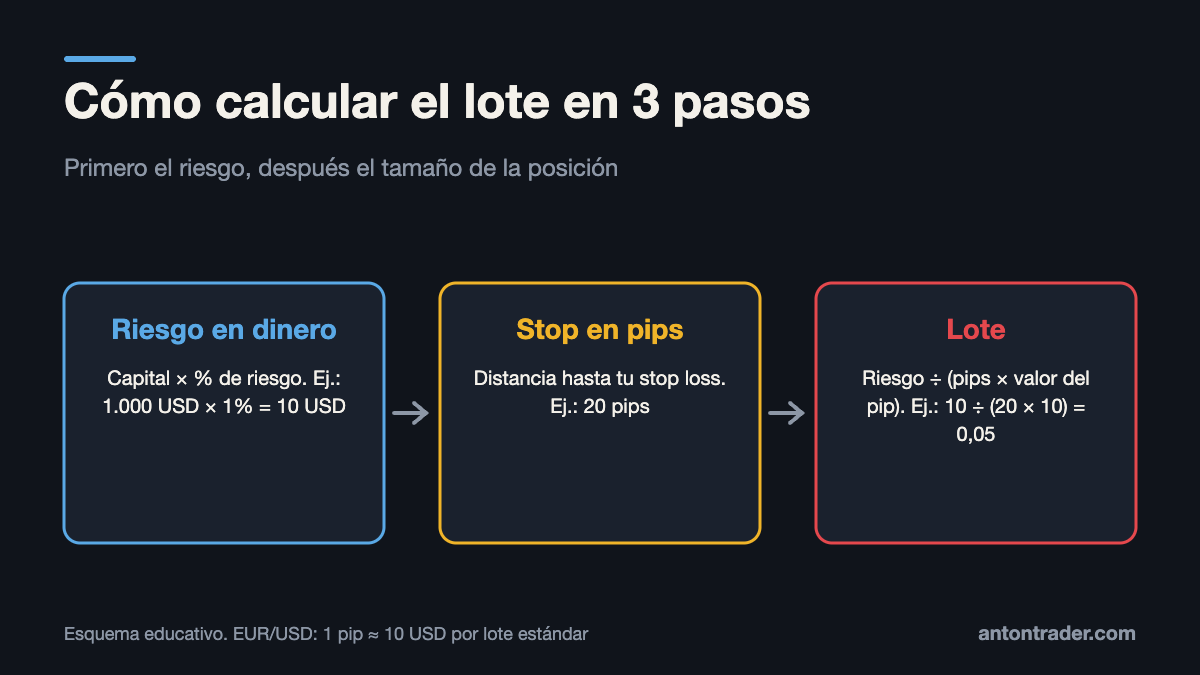
On EUR/USD and most pairs that end in USD, 1 pip is worth about 10 dollars per standard lot. With 10 dollars of risk and a 20-pip stop: 10 ÷ (20 × 10) = 0.05 lots.
Why the stop determines the size
What matters is the order: the market sets the stop (a level, a low, a zone) and the lot size adapts to that stop. If the stop has to be far away, the lot size goes down. If it’s close, it can go up. The risk in money stays the same.
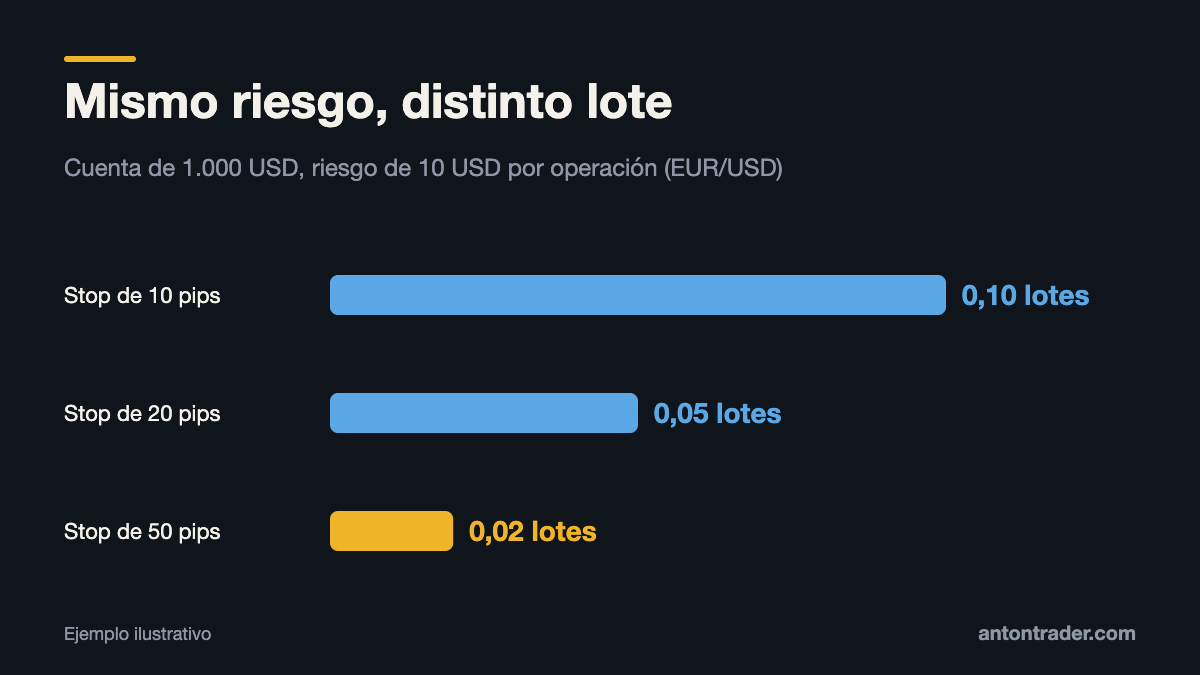
This is how it works in practice: with the same 10-dollar risk, a 10-pip stop allows 0.10 lots and a 50-pip stop allows only 0.02.
Mistakes I see all the time
- Moving the stop to “give it room” without reducing the lot size. Your real risk multiplies.
- Forgetting the pip value. On pairs like USD/JPY or USD/MXN, and on gold or indices, the value per pip is different. Most platforms calculate it for you; check it before entering.
- Confusing leverage with risk. Leverage only lets you open a bigger position. You decide the risk with the lot size and the stop. More in the danger of leverage.
- Stacking correlated positions. Three 1% trades on pairs that move the same way are, in practice, one 3% trade.
To practice, open a demo account or a live one with minimum lots of 0.01, which let you apply this rule even with small accounts. RoboForex, FxPro and Tickmill offer micro lots.
Where to trade
These are the brokers and exchanges I use that work with clients from Latin America. Always check that the service is available in your country, and start small.
Risk warning: CFDs, Forex and crypto derivatives carry a high risk of losing money due to leverage. This article is not investment advice.