The margin in Forex is the portion of your money that the broker locks up as collateral while you have a trade open. If you don’t understand it, sooner or later you’ll get a margin call and the broker will start closing your positions on its own. I’ll explain it with simple numbers.
What Is Margin
When you open a leveraged trade, you don’t put up the full value of the position. You put up collateral, and the broker “lends” you the rest. That collateral is the margin.
The formula is simple: margin = position size ÷ leverage. A standard lot of EUR/USD is 100,000 euros; with the price at 1.1000, 0.1 lot is equivalent to a position of 11,000 dollars. With 1:100 leverage, the margin is 11,000 ÷ 100 = 110 dollars.
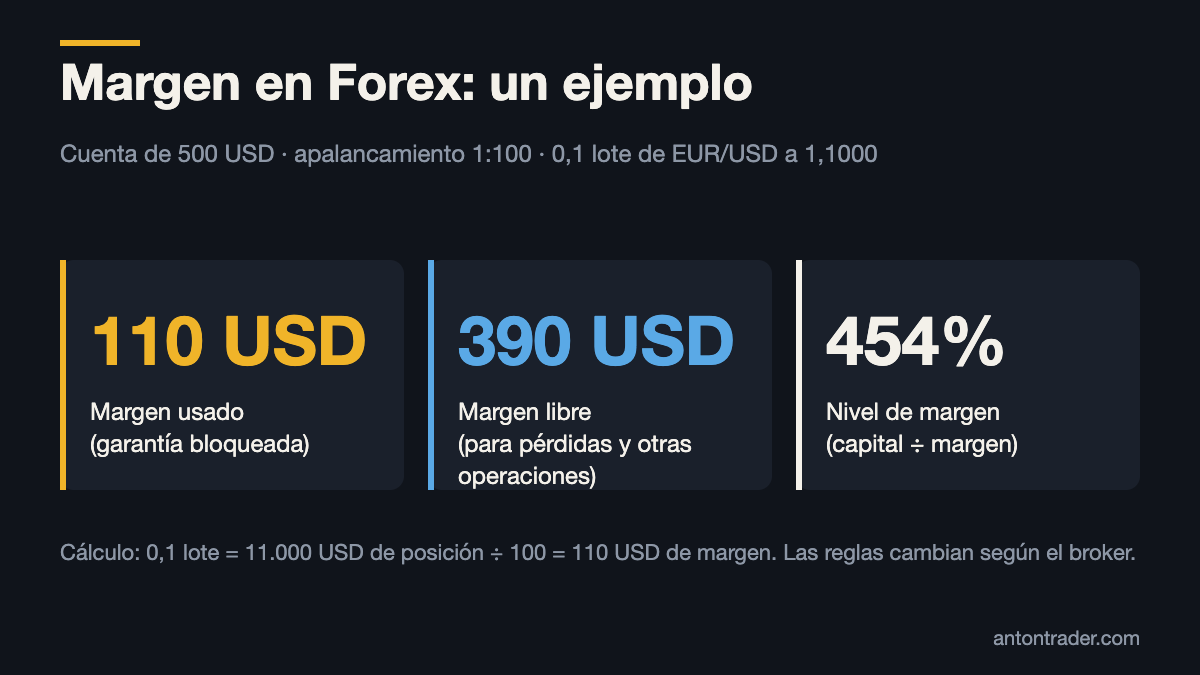
In your terminal (MT4, MT5 or the broker’s app) you’ll see four numbers:
- Balance: the money in the account, not counting open trades.
- Equity: the balance plus or minus the floating profit or loss.
- Margin: what is locked up as collateral.
- Free margin: equity minus margin. It’s your “cushion” to withstand losses and open other trades.
Margin Level, Margin Call and Stop Out
The most important number is the margin level: equity ÷ margin × 100. In the example, with 500 dollars of equity and 110 of margin, the level is 454%. The higher it is, the more comfortable you can be.
If the trade goes against you, equity drops and so does the margin level. That’s where two thresholds come in:
- Margin call: a warning. Many brokers set it when the margin level falls to 100% or close to it.
- Stop out: the broker automatically closes your positions, usually starting with the biggest losing one, so that the account doesn’t go negative. It’s usually at 50% or lower.
The exact percentages vary by broker and account type. Look them up in the trading conditions before you deposit.
The Problem Isn’t Leverage, It’s the Lot
Here’s the trap. Leverage by itself doesn’t increase your risk; what increases it is the lot size you open thanks to it. Look at how many pips against you the same 500-dollar account can withstand depending on position size:
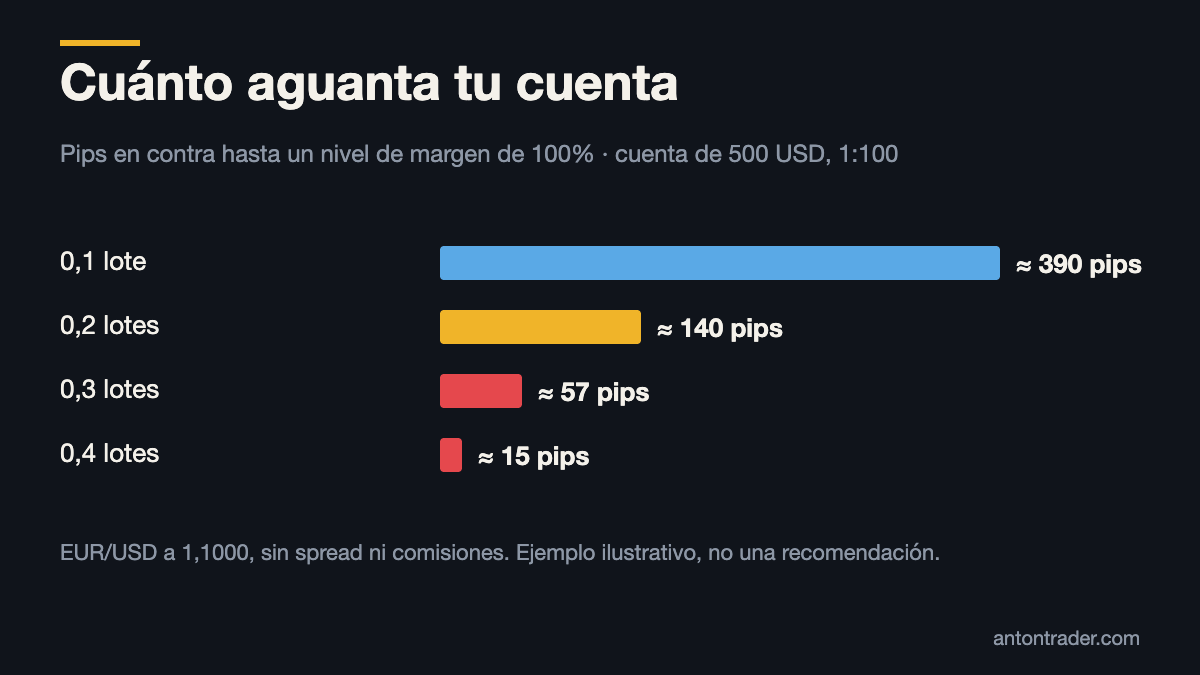
With 0.1 lot you have a cushion of about 390 pips before reaching a 100% margin level. With 0.4 lots, barely 15 pips: a normal move over a few minutes. That’s why I think unlimited leverage is a trap for beginners: it lets you open a huge lot with a small deposit. I prefer brokers with a clear limit, like 1:1000 or 1:2000 at RoboForex.
How to Avoid a Margin Call
- Calculate the lot based on risk, not on available margin. Risk 1% of the account per trade. I explain the formula in how to calculate the lot size in Forex.
- Always use a stop loss. If your stop gets hit before the margin call, the loss is the one you decided on, not the one the broker decides.
- Watch the margin level, not just the floating profit. If it drops below 300–400%, ask yourself whether you’re overloaded.
- Be careful with many trades at once. Five small positions on similar pairs (EUR/USD, GBP/USD, EUR/GBP) can behave like one big one.
- Watch out for news and weekends. The spread widens and the price can gap past your stop.
You can practice all of this for free on a demo account. When you move to a live account, choose a broker with clear, published margin conditions. I use FxPro, RoboForex and Tickmill; with any of them you can see the margin level in real time from your phone.
Where to Trade
These are the brokers and exchanges I use and that work with clients from Latin America. Always check that the service is available in your country, and start small.
Risk warning: CFDs, Forex and crypto derivatives carry a high risk of losing money due to leverage. This article is not investment advice.