I remember moving from the demo account to the live one that very afternoon. I was bored, and it bothered me that I couldn’t withdraw the virtual money I had already made. What I failed to take into account is that:
- I made it with complete indifference to the outcome of each trade;
- I enjoyed every trade from start to finish, no matter how close it was to the stop;
- I didn’t wait: I saw the situation and acted in the moment.
And only 6 years later, when I finally started getting stable results, did I arrive at the same place in the live account:
- I don’t risk an amount that wouldn’t let me forget about the trade;
- I’m interested in watching my forecast play out, even if it ends in a stop loss;
- practice taught me to see the moment and act without hesitation.
My checklist for moving from demo to live
No beating around the bush. No page-long list.
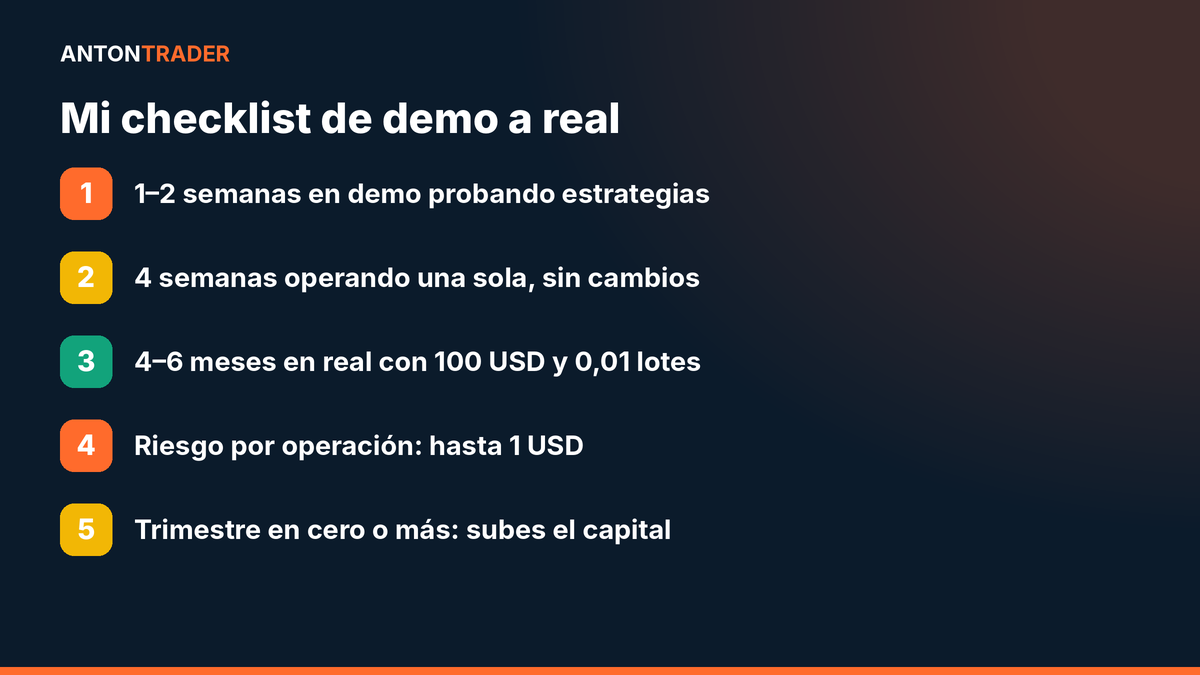
FIRST: on the demo account, I would spend 1–2 weeks testing strategies. And I would choose not the one that makes the most money (that’s temporary), but the one with the least risk. That is, the one where I spent the least time in a loss, closed trades faster, and the price started moving in favor of the order sooner, without long delays.
If your strategy understands the market well, its entry point appears right when the price is already ready to make its move in the right direction.
SECOND: even if it’s hard, I would work with that strategy systematically for 4 weeks. I would forbid myself from changing it because of “sudden flashes of inspiration,” but I would write down all my ideas in a notebook. If at the end of the month the result is just above zero, I move to the live account. But I trade with the smallest lot!
If the strategy lost, I take out my notes from the notebook and improve it. Or I look for a new one and start this stage over again.
THIRD: on the live account, for the first 4–6 months I trade with only $100 and the minimum volume of 0.01 lots, so that the risk per trade is up to $1 of that hundred. For mathematical strategies, I would lower the leverage to 1:10. The important thing here is to learn not to feel emotions about winning or losing money: it has to become a reflex, a default setting. Until I feel that, I don’t move on to a larger capital.
FINAL: if by the end of stage 3 I managed to trade without caring about the outcome and got used to boring, monotonous work, the goal has been achieved. And if I closed that quarter at breakeven or better, it’s time to increase the capital.
Demo account, live account
This simple plan, and therefore easy to remember, lets you train as a trader. It builds the character and willpower for routine and discipline. It lets you choose the best strategy without risking your capital, while polishing along the way the most important thing in trading: discipline and indifference to the outcome, that is, control of your emotions.
Without knowing it, it took me 6 years and over $80,000 lost to learn it on my own. Now I’m sharing it with you here.