The Turtles are the most famous trend-following system in trading history. Everyone knows the legend: in 1983 Richard Dennis bet his partner William Eckhardt that he could teach ordinary people to trade, gathered a group of novices, gave them simple rules… and they made millions. The rules were published long ago. The question is a different one: do they work today? I coded a robot for MetaTrader 5, ran it through 10 years of history and got a result that even I didn’t like. Then I found the market where the Turtles are still alive. I’ll tell you everything as it is, and at the end I’ll give you the robot for free.
The Turtle rules in a nutshell
I took System 1, the classic version described by former participants of the experiment, for example Curtis Faith in the book “Way of the Turtle”.
- Breakout entry. The price closes above the high of the last 20 days: we buy. Below the 20-day low: we sell.
- Exit on the opposite breakout. The long is closed when the price breaks the 10-day low. The short, when it breaks the 10-day high.
- 2N stop. N is the 20-day ATR, the “normal” daily price movement. The stop is placed at two of those movements.
- Pyramiding. If the price moves 0.5N in our favor, we add another position (a “unit”), up to 4 units. The stops of all units move closer to the last entry.
- Position size is calculated so that hitting the stop costs 1% of the deposit.
The essence of the system: many small losses and a few huge trends that pay for everything. The Turtles’ win rate is always low, 25 to 35%. All the profit comes from a handful of trades per year.
How I ran the test
- MetaTrader 5, FxPro demo server, the broker’s real spreads and swaps.
- Period from 2016 to October 2026, $10,000 deposit, 1:100 leverage, 1% risk per unit.
- “1 minute OHLC” mode. Below I explain why it matters: I almost fell into that trap myself.
Three blocks: the classic with no adjustments → optimization using only 2016–2022 → verification on 2023–2026, years the optimizer never saw.
Block 1. The classic: a beating on forex and gold
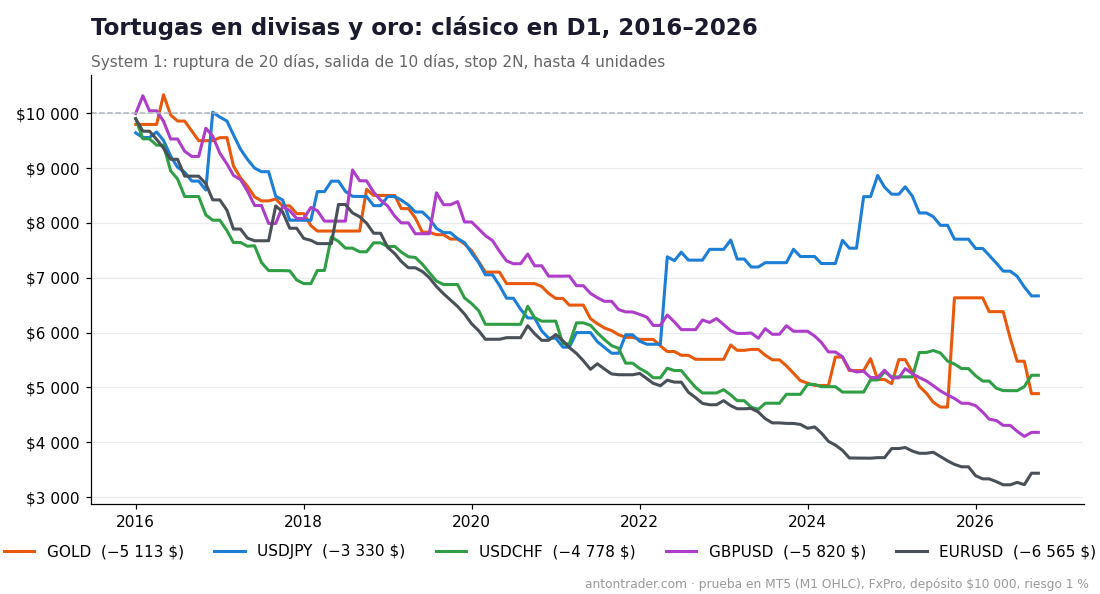
| Instrument (D1) | 10-year result | Profit factor | Max. drawdown | Swaps |
|---|---|---|---|---|
| BITCOIN | +$55,327 | 1.91 | 42.6% | −$29,190 |
| USDJPY | −$3,330 | 0.71 | 46.7% | −$2,216 |
| WTI (oil) | −$2,755 | 0.74 | 49.7% | −$2,898 |
| USDCHF | −$4,778 | 0.44 | 54.3% | −$2,008 |
| GOLD | −$5,113 | 0.53 | 59.0% | −$4,603 |
| GBPUSD | −$5,820 | 0.44 | 62.6% | −$691 |
| EURUSD | −$6,565 | 0.30 | 68.7% | −$678 |
Six out of seven instruments: between −30% and −65% of the deposit. Why does the legend look so bad today?
- Markets have changed. In the 80s there were few trend-following systems and breakouts worked. Today the 20-day breakout is seen by every robot in the world, and most breakouts in forex are false.
- Costs. The Turtles hold positions for weeks. On gold, 10 years of swaps ate up $4,603, almost the entire final loss. Without the swaps, the system on gold would have ended near zero.
- No trends, no money. Currency pairs spend years in a range. A trend-following system has nothing to do there.
And one exception: bitcoin. +$55K on $10K. Not because the system is magic, but because bitcoin had real trends: 2017, 2020–2021, 2024. The Turtles were invented for exactly this kind of market. But look at the swaps: $29K, more than half of the net profit. And a 43% drawdown is huge.
Block 2. The optimization… and the trap I almost fell into
First, like many people, I tried to “rescue” gold. The optimizer in fast mode (“open prices only”) found beautiful parameters: a profit in 2016–2022 and an even bigger profit in 2023–2026. I was about to give them to you.
But before publishing I rechecked those same parameters in the accurate “1 minute OHLC” mode. And they turned negative: −$2,135 in the training period and −$1,522 in the verification period. The reason is simple: in fast mode the tester checks stop losses only at the bar’s open. For a system that places stops and adds positions within the day, that picture isn’t real. So I ran the full gold optimization in accurate mode: none of the 1,152 combinations was profitable in 2016–2022.
To make it clear, the same on USDJPY. In accurate mode the optimizer found 77 profitable sets in 2016–2022; the best, +$11,744 with a profit factor of 3.5. A beauty. In 2023–2026 all 77 ended up negative, and the best of them lost $2,561. This is what curve fitting looks like: the past is explained perfectly, the future isn’t.
The conclusion for everyone who buys robots: ask in which mode the test was done. An “open prices” report for a system with intrabar stops is a drawing, not a test.
Then, bitcoin. The optimization was done only on 2017–2022 (the BITCOIN history at FxPro starts in May 2017). The entry channel, exit channel, stop, number of units and the step for adding were adjusted. Of 161 sets tested, 143 were profitable in the training period: in this market the system has a real edge, not a lucky combination.
I didn’t pick the most profitable variant. I took the one that nearly matches the classic, but with a shorter stop and fewer units, to reduce the drawdown:
| Parameter | Classic | Optimization (BITCOIN D1) |
|---|---|---|
| Entry channel | 20 days | 20 days |
| Exit channel | 10 days | 10 days |
| Stop | 2N | 1.5N |
| Max. units | 4 | 3 |
| Step for adding | 0.5N | 1N |
Block 3. Forward 2023–2026
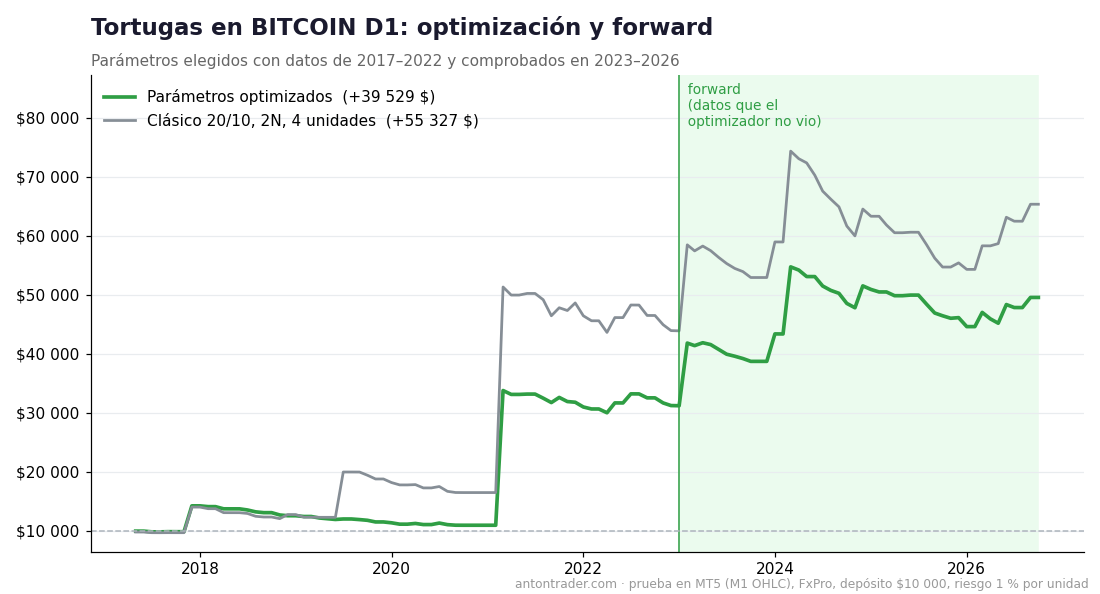
| Variant | Period | Result | Profit factor | Max. drawdown | Trades |
|---|---|---|---|---|---|
| Classic | 2017–2022 | +$33,905 | 2.45 | 42.6% | 163 |
| Optimization | 2017–2022 | +$21,200 | 2.64 | 38.7% | 131 |
| Classic | 2023–2026 (forward) | +$4,881 | 1.64 | 33.3% | 130 |
| Optimization | 2023–2026 (forward) | +$5,872 | 1.80 | 26.3% | 100 |
Each period was tested separately, starting with $10,000. What we see:
- In the forward test, the optimized variant beats the classic on every count: more profit, a higher profit factor, a drawdown 7 percentage points lower, fewer trades and fewer commissions.
- In the training period the classic earned more, thanks to the four units in the wild trends of 2017 and 2020–2021. That’s why, on the chart for the whole period, the gray line sits higher: +$55K versus +$39.5K. Here the optimization isn’t about “earning more”, but about having a calmer curve.
- Swaps. Over the whole period, the optimized variant left the broker $18,206 in swaps out of $58,214 in gross profit. That’s the price of holding positions for weeks.
Of the 143 profitable sets in the training period, 90 stayed positive in the forward test. It’s a good sign: the edge doesn’t depend on a single lucky number.
The risks, without makeup
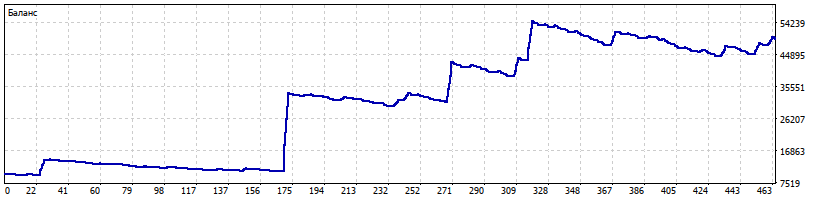
- Drawdowns are going to be deep. Even in the optimized variant, the maximum drawdown is nearly 40% in the training period and 26% in the forward test. A trend-following system loses little by little for months and then recovers everything with a single trade. It’s psychologically hard, which is why you leave it to a robot.
- Swaps decide. On bitcoin they took almost a third of the gross profit. Crypto swaps vary enormously from one broker to another: compare them before you start.
- A single instrument is a risk. If bitcoin enters years without trends, the system is going to lose. That’s why you should keep the risk per unit at 0.5–1%, no more.
If you optimize the robot periodically, for example once a year using the latest years and always verifying with a forward test, you can keep it in shape. The optimized .set in the file shows the result this approach gives.
Where to run the robot
The robot works on MetaTrader 5 with any broker that offers bitcoin (or another trending instrument). My test was done on FxPro. The other brokers in my ranking also work: RoboForex and Tickmill. Check that the broker you choose offers cryptocurrencies on MT5 and how much it charges in swaps.
Download the Turtles robot for free
The robot is free for clients of the brokers in my ranking:
- Open a MetaTrader 5 account with one of the brokers above (or use the one you already have).
- Go to the Telegram bot with the button and send your account number.
- After verification, the bot sends you the file: the robot, the classic Turtle parameters and the ones optimized for bitcoin, plus the instructions.
🐢 Download the robot for free on Telegram
My conclusion
The Turtle legend is half true. The rules still win, but only where there are strong trends. On forex and gold, the classic system simply burned through the deposit over the last 10 years, and no optimization in honest mode fixed it. On bitcoin it works and passes the test with new data, but it demands nerves of steel and attention to swaps.
For comparison: the short-term system Connors RSI-2 on the pound did pass the forward test: 41 out of 58 sets stayed positive.
The main lesson isn’t even about the Turtles. A pretty tester report is worth nothing until you know in which mode it was done and whether it was verified with data the optimizer didn’t see. I myself was about to give you “profitable” parameters that actually lose money. Backtest results do not guarantee future results.
Sources
- Curtis Faith — “Way of the Turtle”, 2007.
- My own tests in MetaTrader 5 on the FxPro demo server, October 2026.
Where to trade
These are the brokers and exchanges I use that work with clients from Latin America. Always check that the service is available in your country and start small.
Risk warning: CFDs, Forex and crypto derivatives carry a high risk of losing money due to leverage. This article is not investment advice.