Remittances to Guatemala keep breaking records in 2026. According to the Bank of Guatemala (Banguat), $20,015.7 million arrived between January and September, 5.5% more than in the same period of 2025, and July was the highest month in the entire historical series. I’ll tell you what the numbers say and how to protect that money when it arrives.
The 2026 figures, month by month
The year started strong: March brought $2,441.8 million, almost 22% more than a year earlier, and July reached $2,468.6 million, the monthly record since the series began (2002). Not every month grew: May and August came in slightly below 2025.
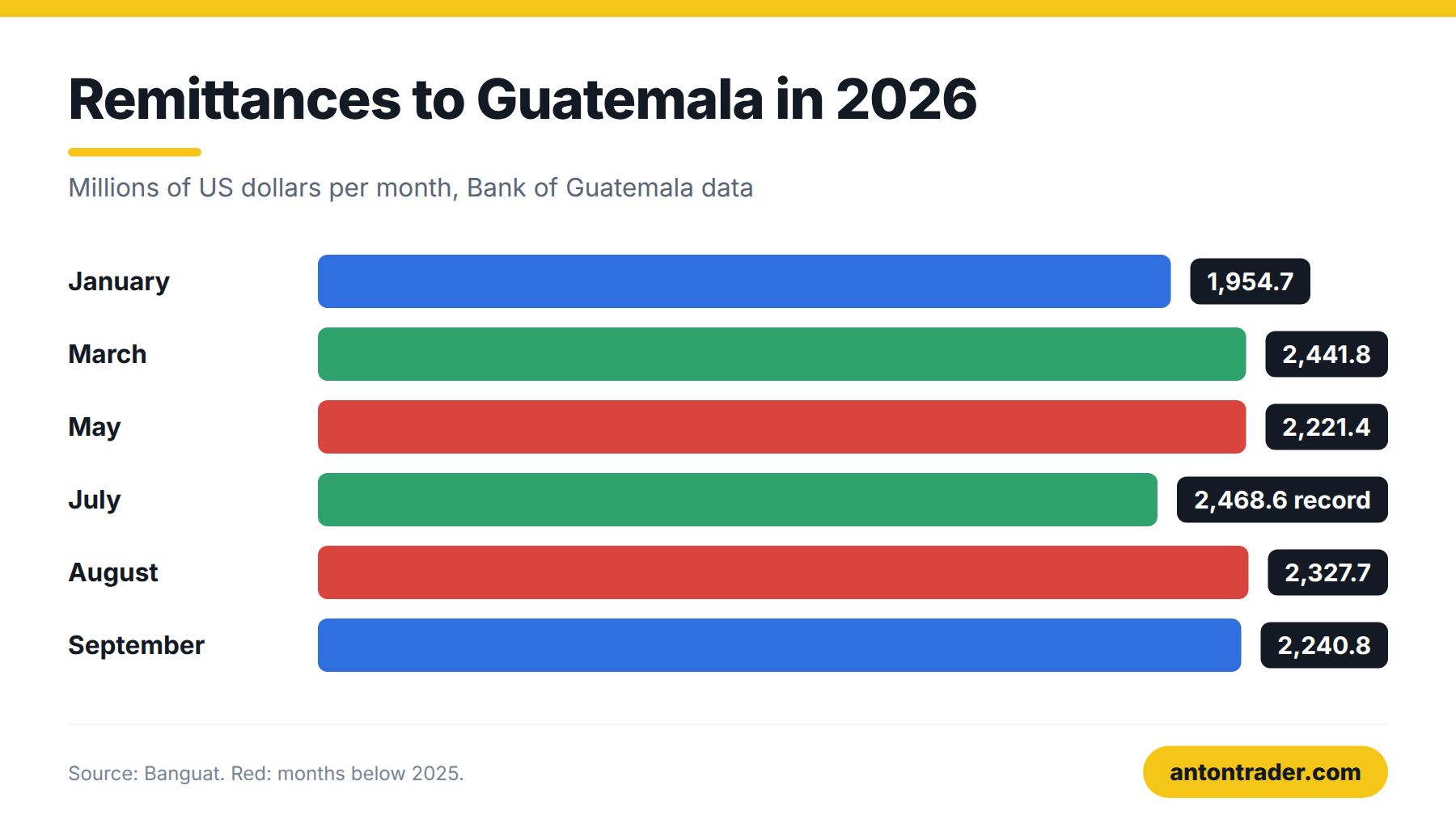
| Period | Remittances 2026 | Change vs. 2025 |
|---|---|---|
| March | $2,441.8 million USD | +21.9% |
| July (record) | $2,468.6 million USD | +4.3% |
| September | $2,240.8 million USD | +6.4% |
| January–September | $20,015.7 million USD | +5.5% |
| Through October 22 | $21,694.2 million USD | +5.7% |
Source: Bank of Guatemala, family remittances series.
Why they keep growing
Behind these numbers there are millions of families. Migrants keep sending money consistently, month after month, and the October cumulative total already exceeds 2025. One detail to keep in mind: since January 2026 the United States charges a 1% tax on transfers paid in cash, which pushed more people to send from bank accounts or cards.
For Guatemala, remittances are enormous: they account for a very large part of the economy and support the consumption of a large share of the country. Something similar happens with remittances to Mexico, although the 2026 trend there was different.
How to protect the money that arrives
A remittance takes a lot of hard work. That’s why it hurts to see how much is lost to fees and exchange rates, or how much is spent without a plan. Here are some practical ideas:
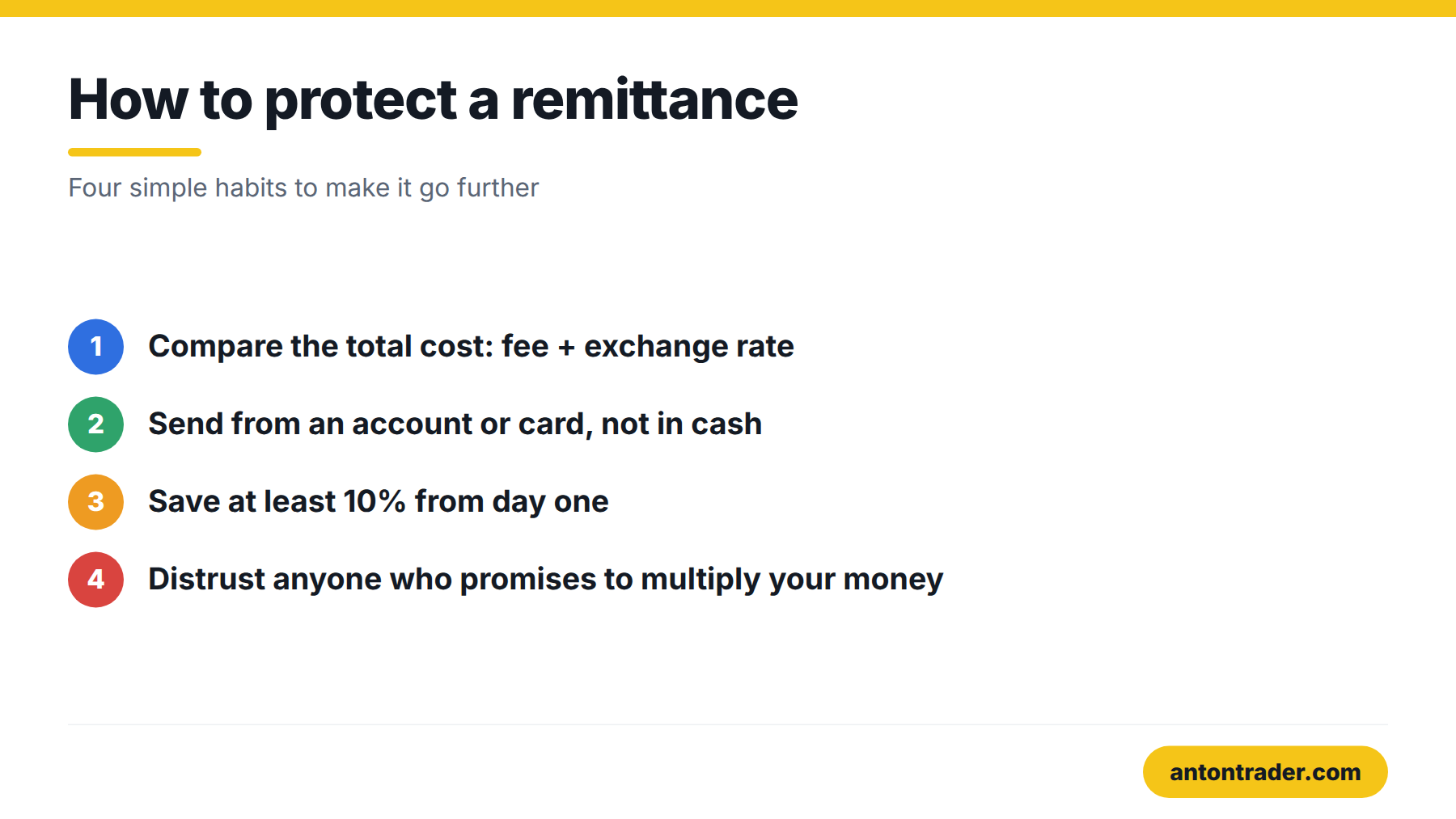
- Compare the total cost, not just the fee. Many companies charge “zero fees” but give you a worse exchange rate. Check how many quetzales your family receives for every 100 dollars.
- Send from an account or card, not in cash. This way you avoid the 1% tax in the United States and there is a record of the transfer.
- Set aside a portion for savings from day one. Even if it’s just 10%. The quetzal has been a stable currency, so saving in local currency makes sense; if you want a portion in dollars, make it a decision, not an impulse.
- Be wary of anyone who promises to multiply the remittance. Groups that offer to “invest” your money with fixed weekly returns are the most common way to lose it.
What about trading?
Trading is not a way to multiply a remittance. It is a skill that is learned over time, with money you can afford to lose and starting on a demo account. If you want to take that step, do it with large brokers with years of history, such as FxPro, RoboForex or Tickmill, and with small amounts until you understand how it works.
Where to trade
These are the brokers and exchanges I use that work with clients from Latin America. Always check that the service is available in your country and start small.
Risk warning: CFDs, Forex and crypto derivatives carry a high risk of losing money due to leverage. This article is not investment advice.