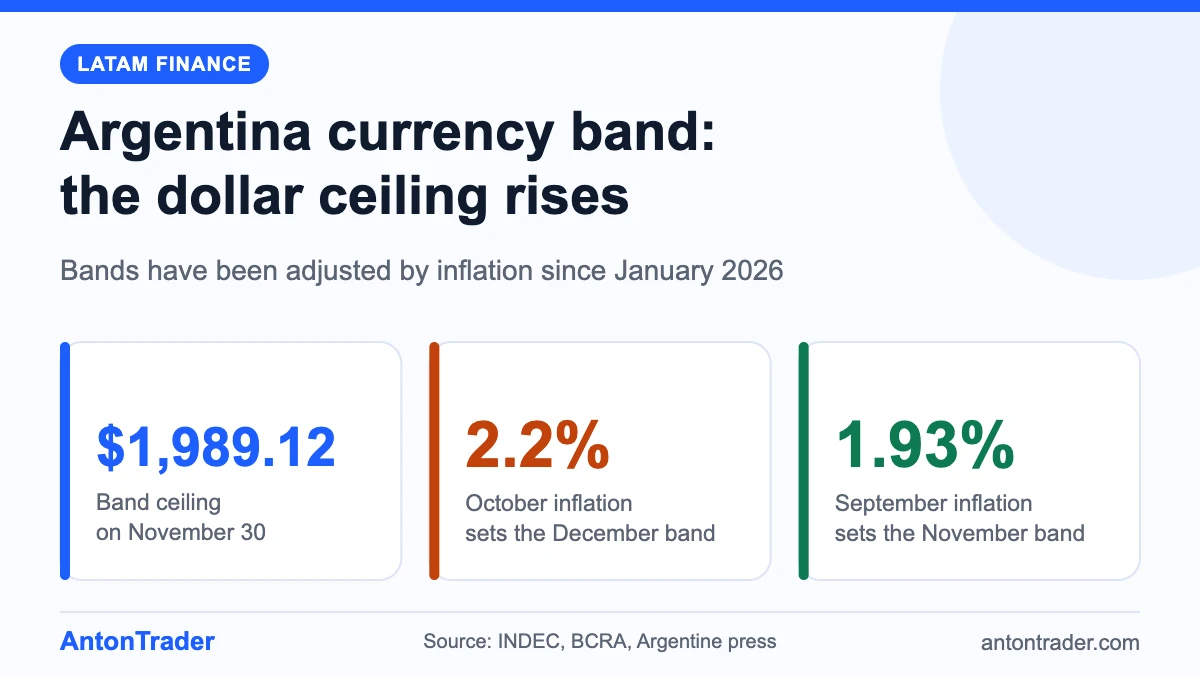
The exchange rate band in Argentina keeps rising month after month. The ceiling for the wholesale dollar closes November at $1,989.12, and with October’s 2.2% inflation it gets close to $2,000 in December. I’ll walk you through how it works, how far the dollar is from that limit, and what changes for your pesos.
What changed in the exchange rate band
Since January 1, 2026, the Central Bank (BCRA) no longer moves the band a fixed 1% per month, as it had done since April 2025. Now it adjusts the band by the inflation published by INDEC, with a two-month lag. So September’s inflation of 1.93% determines how the November band moves. And October’s 2.2% determines December’s.
The ceiling doesn’t jump all at once on the first day of the month: it rises a little each day. According to calculations published by Forbes Argentina, El Economista, iProfesional and Perfil, on the last business day of November it reaches $1,989.12.
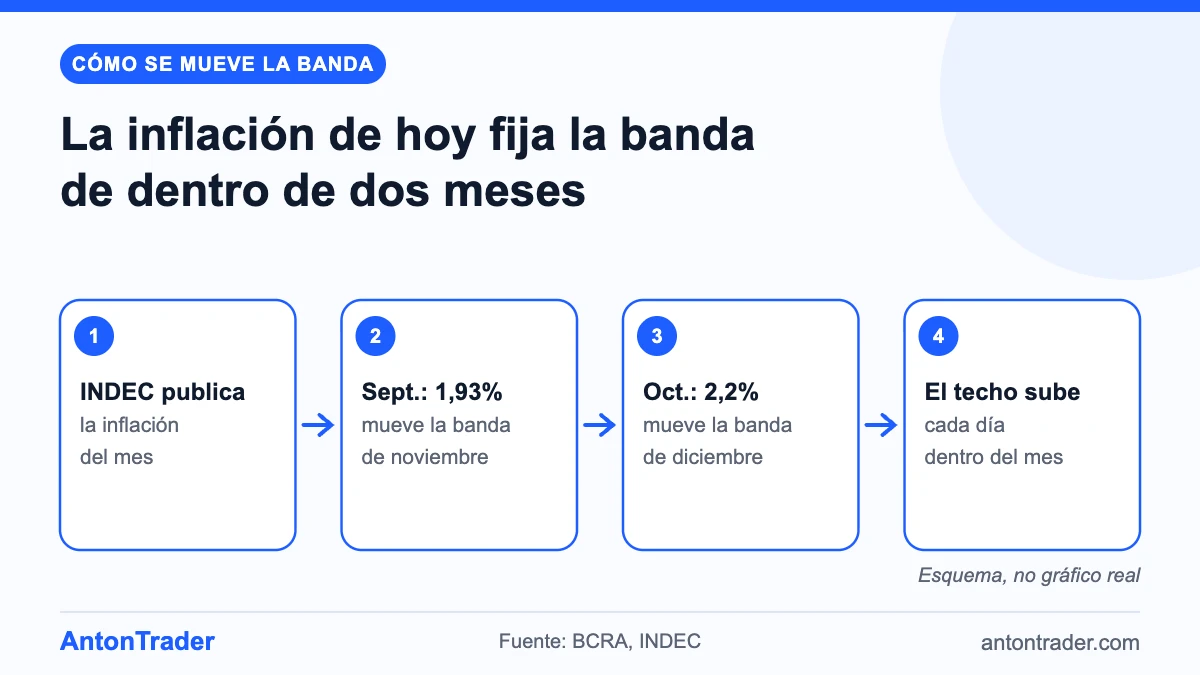
One important detail, which Perfil pointed out: the formula does not subtract US inflation. That’s why the ceiling rises a bit faster than the “real” dollar, and the room for the peso widens over time.
How far the dollar is from the ceiling
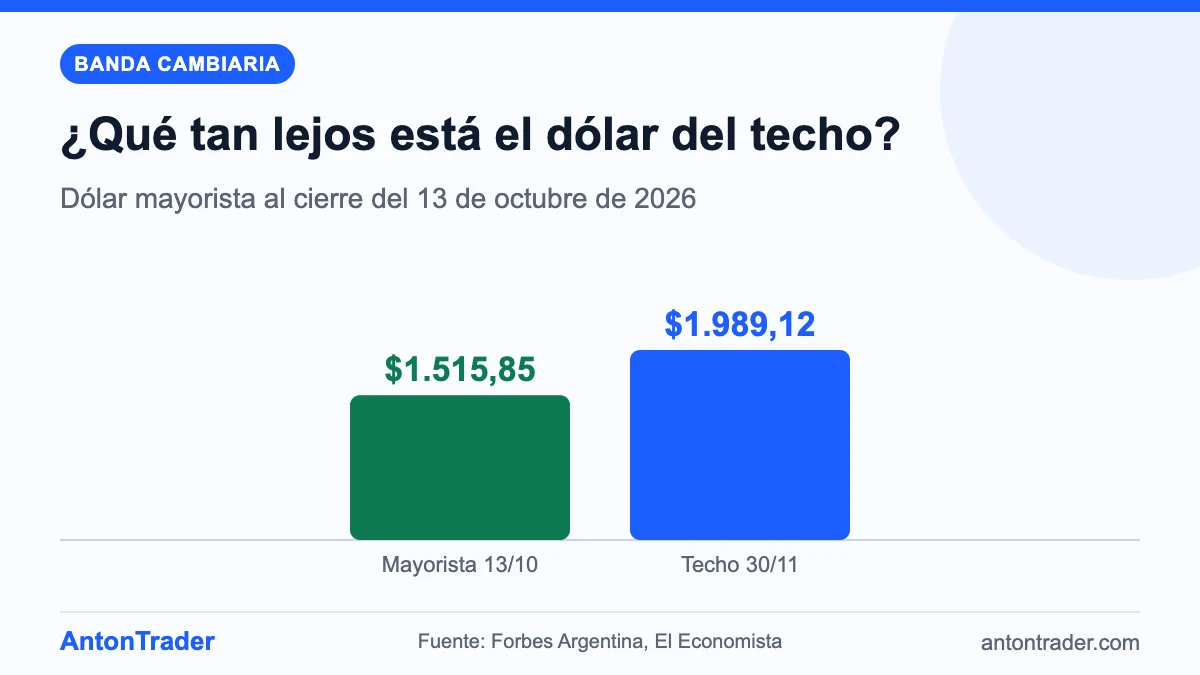
Right now the dollar is quite far from the limit. On October 13 the wholesale dollar closed at $1,515.85. To touch the end-of-November ceiling it would have to rise $473.27, or 31.22%, according to Forbes Argentina and El Economista. At the start of November the gap was still large.
The rules of the game are simple:
- Inside the band, the market sets the price. The BCRA can step in from time to time to curb sharp jumps.
- If the dollar touches the ceiling, the BCRA sells dollars and withdraws pesos.
- If it touches the floor, the BCRA buys dollars and issues pesos.
The ceiling is not a price target. It is the line where the Central Bank commits to intervene. The fact that it rises doesn’t mean the dollar will go all the way up there.
Why October’s inflation matters
October’s 2.2% was the highest reading since April. Since the band copies inflation with a two-month delay, that number is already “baked into” December’s ceiling. If inflation accelerates again in the coming months, the ceiling will also accelerate in January and February.
What I see here is a clear signal: the band is no longer a fixed anchor for the dollar. It is a limit that moves with prices. For anyone saving in pesos, that means the Government accepts that the official dollar can rise at the pace of inflation without the Central Bank spending reserves.
What it means for you
- Your pesos lose value at the pace of inflation. With 2% monthly, idle money shrinks fast. Plan your big purchases with that in mind.
- The $2,000 ceiling is a limit, not a forecast. Don’t buy dollars in a panic because of a headline. Look at the real distance between the wholesale dollar and the ceiling.
- Diversify gradually. Part in dollars, part in other assets, never everything in one place.
- Watch the next inflation report. November’s figure, which INDEC publishes in mid-December, will define January’s band.
If you want to trade the dollar or gold from Argentina with a dollar account, use brokers with years of track record such as FxPro, Tickmill or RoboForex, start on a demo account and then with a small amount of money. To buy crypto or stablecoins, BingX and Bybit are the exchanges I have at the top of my rating.
Sources
- Perfil: the BCRA set a new ceiling for the exchange rate band
- Forbes Argentina: the dollar could approach $2,000
- El Economista: the new November ceiling
- iProfesional: what the ceiling for November is and when the BCRA intervenes
Everything written here is my personal opinion and experience, not investment advice. Trading CFDs, Forex and leveraged cryptocurrencies carries a high risk of losing money.