In this article I want to share with you the strategy that I consider the most reliable for trading Forex and cryptocurrencies. It uses no indicators, so there are no settings to optimize. It is designed to profit in both the long term and intraday: it combines the safety of investing with the returns of intraday trading. That way you can use both styles to grow your deposit.
As is well known, the most reliable strategy in the markets is buy and hold. This simple technique shows its enormous advantage every year over any “high-return” strategy that wipes out all of a trader’s money in the first sharp drop. But today, for the first time, we are upgrading it. We teach it not only to buy for the long term, but also to sell (not everything in a trader’s life is an uptrend). And we add an intraday trading system based on the 20/80 rule.
In short, within a single trading account we create a true investment fund, with room for diversification and for increasing total profit. The strategy requires your attention and study, like everything worthwhile. But I am sure that if you apply it with discipline, the end of the year will make you happy, no matter where bitcoin closes.
Technical setup
- Trading terminal: MetaTrader, TradingView or cTrader.
- Timeframes: M5, H1 and W1 (all of them are used!).
- Assets: top 30 cryptocurrencies and major Forex pairs.
- Trade management with stop loss, take profit and limit orders.
- Leverage: from 1:10 upward. The position size depends on the global structure.
- Hedging account type: the ability to open buy and sell orders at the same time.
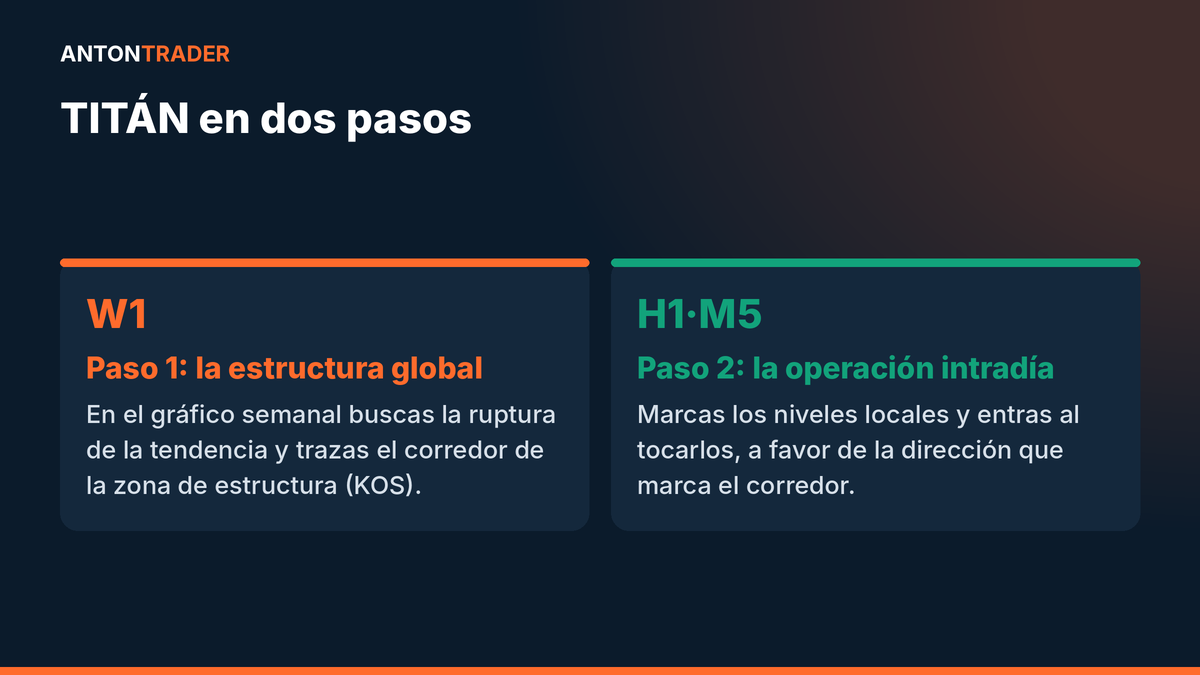
Step 1: define the global structure
In the first step we need to find the breakout zone of the market structure. From that zone we will look for long-term investment trades and the direction for intraday positions. We need to find a trend structure and the impulse that breaks it.
What matters to us is the structure wave on the weekly chart that was the last impulse of the broken trend. We draw a corridor between its start and its end. If the price is above that corridor, the direction for the 1-hour and 5-minute charts is buying.
On the exit from that corridor, on the retest of one of its edges (or of the levels that appear afterward), we find the first entry point on the weekly chart. This is our investment position, with a long-term target at the nearest weekly extremes.
It is important that, when the edge of the “structure zone” corridor is touched, a TOP-3 pattern forms in the direction of the retest. Entry on a retest can also be considered at any other level above or below this zone. During the strategy we can both buy and sell the asset, which is why on a crypto exchange you can only trade futures.
Step 2: look for the intraday trade on M5 or H1
Once we build the KOS (structure zone corridor), we already know the direction of intraday trading for practically a whole year. Now it is enough to mark the visible levels at the local correction and reversal points. Then we enter when the price touches those lines and a confirmation pattern appears there (or simply at the close of a candle in our direction).
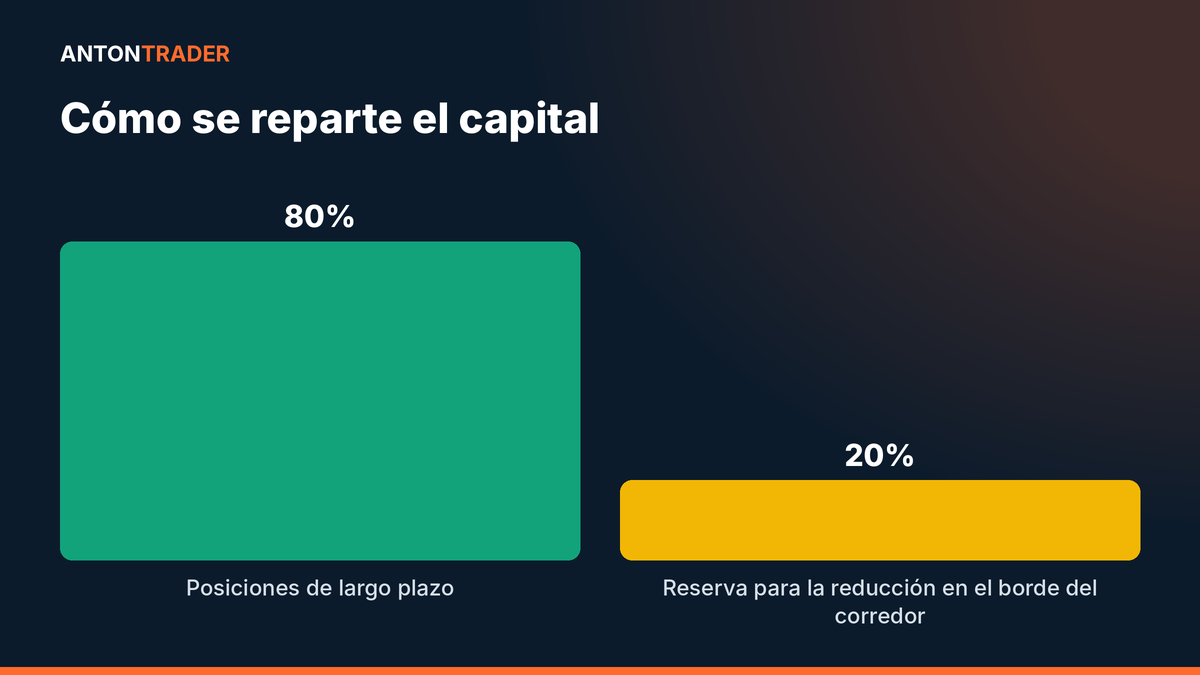
The most important thing here is not the chart analysis itself, but calculating the position size correctly. Our task, after entering, is to place the averaging lines so that, if the market goes against us, the drawdown at the extreme edge of the KOS is 20%. In other words, for long-term positions we always reserve 80% of the capital.
Take profit, stop loss and averaging
The targets for intraday and long-term positions are always at the nearest local level. Of course, on W1 and on H1 these will be completely different distances. For long-term buys I would recommend doing without a stop loss, because the size of that position is usually around 5% of total capital. For sells, however, the stop is mandatory, and it must be placed beyond the extreme edge of the KOS.
A stop loss makes no sense in intraday trading for several reasons:
- we see trading as a mathematical formula in which the market always “returns to the mean”;
- the position size calculation is based on reaching a 20% drawdown when the KOS is touched;
- a stop loss would only eat the profit, while averaging helps us exit without a loss once the trend correction ends.
⚠️ Remember: trading without a stop loss and with averaging demands a strict position size calculation. Without it, the risk is very high.