The Forex market hours have just changed for almost all of Latin America: the United States and Europe turned their clocks back, and the London and New York sessions now start one hour later in your local time. Here are the updated hours for your country and the times when it’s really worth trading.
Forex is open 24 hours, but not all hours are equal
The currency market has no central building. It runs through banks and brokers around the world, so it is open from Sunday afternoon to Friday afternoon, without a break. But volume is concentrated in four major sessions: Sydney, Tokyo, London and New York.
When volume is higher, the spread is lower and price moves more cleanly. When it’s low, the spread widens and strange moves appear. That’s why the time you trade matters as much as your strategy.
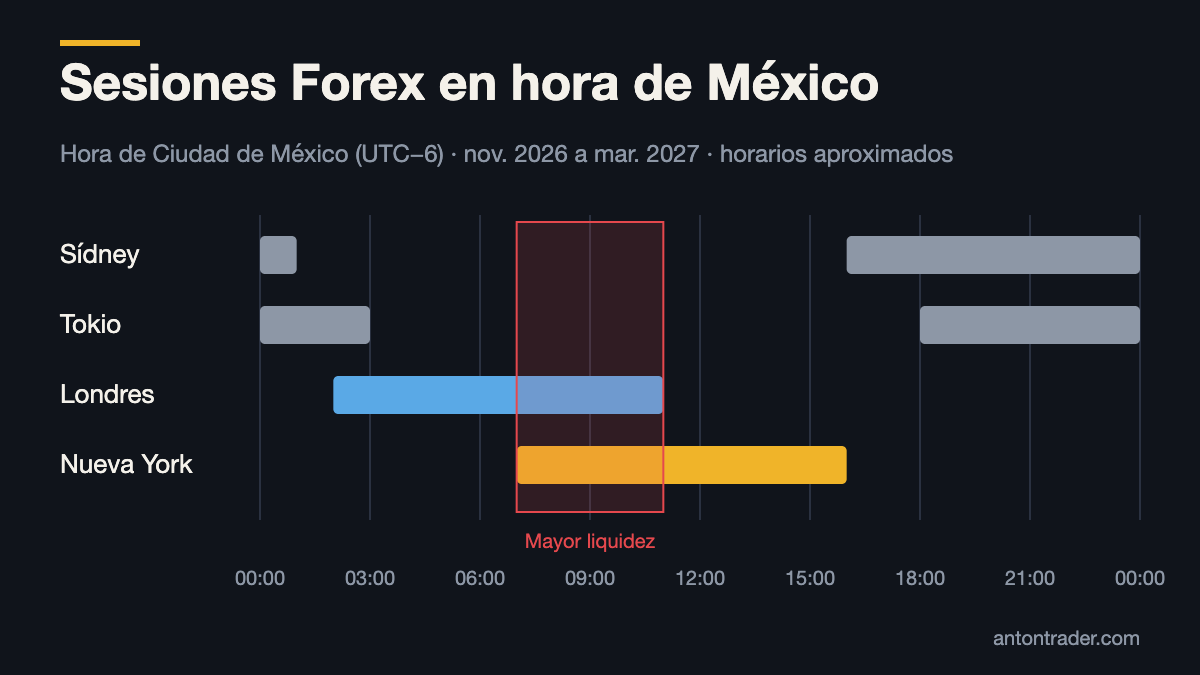
Session hours in your country
These hours are valid from November 2026 to March 2027, when daylight saving time ends in the United States and Europe. They are approximate: each broker publishes its own.
| Country (time zone) | Sunday open | London | New York | Overlap |
|---|---|---|---|---|
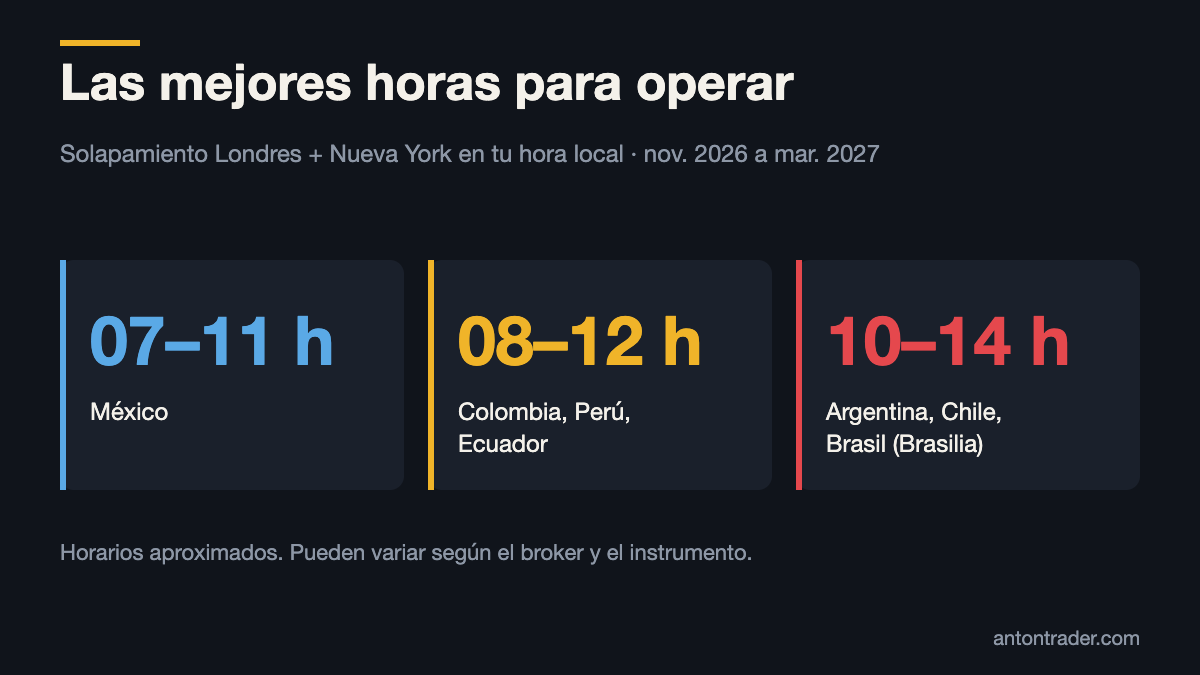
| Mexico, Mexico City (UTC−6) | 16:00 | 02:00–11:00 | 07:00–16:00 | 07:00–11:00 |
| Colombia, Peru, Ecuador (UTC−5) | 17:00 | 03:00–12:00 | 08:00–17:00 | 08:00–12:00 |
| Venezuela, Bolivia (UTC−4) | 18:00 | 04:00–13:00 | 09:00–18:00 | 09:00–13:00 |
| Argentina, Chile, Brazil-Brasília (UTC−3) | 19:00 | 05:00–14:00 | 10:00–19:00 | 10:00–14:00 |
The Friday close is at the same time as the Sunday open: for example, 16:00 in Mexico City or 17:00 in Bogotá and Lima.
The best hours to trade
The moment of the day with the most liquidity is the London and New York overlap: the two largest financial centers are open at the same time. During those four hours, EUR/USD, GBP/USD, gold and the US indices move strongly.
Some practical ideas depending on what you trade:
- Dollar pairs and gold: the overlap is your best window. Important US data (employment, inflation) usually comes out at 8:30 New York time, which is 7:30 in Mexico City and 8:30 in Bogotá during winter time.
- Mexican peso (USD/MXN): it has more volume during the New York session, which coincides with Mexico’s business hours.
- Yen and Australian dollar: they move more during the Asian session, which for us is at night.
- Avoid the Sunday open: the spread is usually very wide and there can be price gaps relative to the Friday close.
A huge advantage of living in Latin America: the market’s best window falls in the morning or around midday. You don’t have to stay up late to trade at the moment of highest liquidity. If you work in an office, a strategy on higher timeframes (H1 or H4) that doesn’t force you to be in front of the screen all day might suit you better.
What about crypto?
Cryptocurrencies on an exchange like Bybit or BingX trade 24/7, including weekends. Crypto CFDs at a broker have their own schedule, which depends on each company. Check it in the instrument specifications.
Heads up in March 2027: when the United States and Europe move their clocks forward again, these hours will shift one hour earlier in most countries in the region. In Chile, which also changes its time, the adjustment is different. Save this table and review it in the spring.
If you’re going to trade in these windows, you need a broker with good execution during high-volume hours. I use FxPro, RoboForex and Tickmill; with all three you can see the hours for each instrument directly in MT4 or MT5.
Where to trade
These are the brokers and exchanges I use that work with clients from Latin America. Always check that the service is available in your country, and start small.
Risk warning: CFDs, Forex and crypto derivatives carry a high risk of losing money due to leverage. This article is not investment advice.