Knowing how to withdraw money from a broker is just as important as knowing how to trade. Many Latin Americans worry about how to deposit and only discover the problems when they want to take out their profits. Here is my practical guide, based on what I’ve learned in 14 years in the market.
Before you need the money
The best time to prepare your withdrawal is the day you open the account, not the day you need the money.
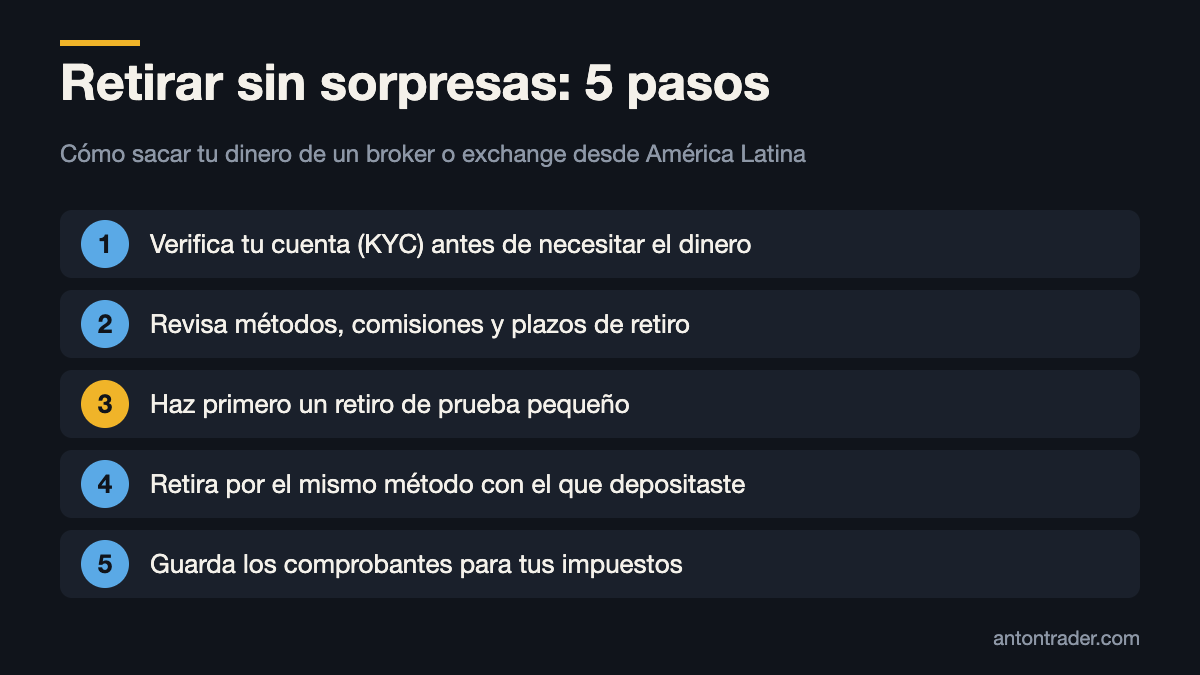
- Verify your account (KYC) from the start. Every serious broker will ask for an ID and proof of address before your first withdrawal. If you leave it for later, your first withdrawal gets delayed by days because of paperwork you could have done earlier.
- Read the withdrawals section. Which methods are available for your country, how much they charge, how long they take, and whether there is a minimum.
- Check how profits come out. Some companies let you deposit with one method but only withdraw profits through another, for example an international bank transfer. If you don’t have that method at hand, your money can get stuck. I prefer the withdrawal channel to be clear from the first deposit.
The same-method rule
Almost all brokers apply the rule of returning money by the same route it came in. It is an anti-money laundering rule, not a whim. In practice:
| Method | How the withdrawal usually works | Watch out for |
|---|---|---|
| Card | Refunded to the card up to the deposited amount; the rest through another method | Issuing bank processing times |
| Bank transfer | Arrives in your account in dollars or local currency | Intermediary bank fees and several business days |
| E-wallets | Usually fast | Availability in your country and the wallet’s fee |
| Crypto (USDT and others) | Fast and with no banks in between | Choosing the right network and the network fee |
With crypto, the typical mistake is sending over a network different from the one your wallet supports. Copy the address, check the network twice, and start with a small amount. If you later convert USDT to pesos on an exchange like Bybit or BingX, also consider the exchange’s fee and exchange rate.
Make a test withdrawal
My number one piece of advice: before depositing a large amount, deposit a little and withdraw a little. It is the only real test of a broker. I once compared withdrawals from several brokers on video: FxPro and RoboForex paid out in under an hour. At Tickmill, my last withdrawal to crypto took a little over a day, but it arrived without asking me for explanations or extra paperwork.
A withdrawal can be delayed for normal reasons: pending verification, a weekend, bank holidays, or a security review. What is not normal is total silence from support for weeks.
Red flags
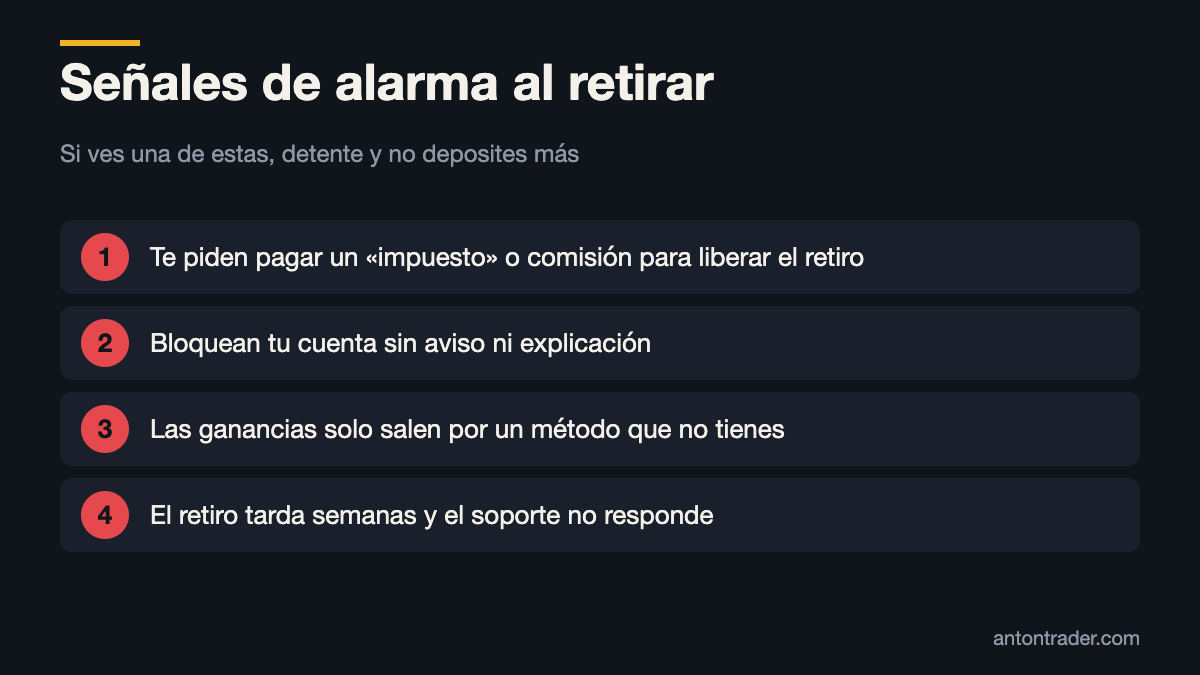
- They ask you to pay a “tax” or a fee upfront to release your withdrawal. A real company deducts its fees from the withdrawn amount. If they ask you to transfer more money so you can take out yours, it’s a scam.
- They block your account without notice. Yesterday you could log in, today your password doesn’t work and the codes don’t arrive. It’s a scheme I’ve seen at dubious companies.
- They offer to “recover” your lost money in exchange for a payment. If you were scammed, no recovery lawyer will get it back for you; those who offer that are usually other scammers. More details in trading scams: the fake manager and the fake recovery agent.
One last point: trading profits may be taxable depending on your country. Keep records of your deposits and withdrawals and consult a local accountant.
If you haven’t yet chosen where to trade, start with large brokers with years in the market, and do your withdrawal test before scaling up. My guide on how to deposit from Latin America without losing money to fees may also help you.
Where to trade
These are the brokers and exchanges I use and that work with clients from Latin America. Always check that the service is available in your country, and start small.
Risk warning: CFDs, Forex, and crypto derivatives carry a high risk of losing money due to leverage. This article is not investment advice.