Bill Williams’ Awesome Oscillator comes built into every MetaTrader: green and red bars around the zero line. Its rules are simple: if the bars cross zero or draw a “saucer,” momentum has changed. I tested the classic version on seven markets over 72 months, and on most of them it barely moves forward. But on gold the idea worked and held up through two years of data the optimizer never saw. Below you’ll find the gold robot on H4, its results, real trades on the chart, and how to download it for free.
- +152.8% in 72 months on gold (GOLD) H4 with 1% risk per trade. Maximum drawdown: 18.5%.
- +70.0% in the forward test (10/2024–09/2026) with a profit factor of 2.31: the robot made money on data it didn’t see during tuning.
- With 2% risk per trade, the same robot returned +448.2% in 72 months with a 33.5% drawdown.
- In the archive: the robot ready for MetaTrader 5, the parameter file for gold H4, and the instructions. It’s up and running in 5 minutes.
📊 Download the Awesome Oscillator robot for free
What the robot does
Bill Williams described the Awesome Oscillator in his book “New Trading Dimensions” (1998). It is the difference between two simple moving averages of the candle’s median price: SMA 5 minus SMA 34. A bar above zero means short-term momentum is stronger than long-term momentum; below zero, weaker. Williams gave three signals with it; the robot takes the two clearest ones:
- Zero-line cross: the histogram goes from negative to positive, and momentum has turned up.
- “Saucer”: the histogram is above zero, one bar goes down (red) and the next goes back up (green): the pullback within the uptrend is over.
- Buys only, and only with the trend: the H4 candle must close above the EMA 100. On gold the robot doesn’t open sells.
- Stop: 1 ATR(14) from the entry. There is no take profit: the robot holds the trade until the AO gives the opposite signal, a downward zero cross or a downward “saucer.”
- Position size: based on risk as a percentage of the balance. In the test, 1%; in the parameters you can set your own.
It’s classic trend-following logic: many small stops and a few long trades that cover them. Only 26% of trades close in profit, and it’s worth knowing that before you start.
What it looks like on the chart
Below are two real trades from the robot in the gold H4 test. Both are from the forward period, which the optimizer didn’t see: one winner and one loser. Below is the Awesome Oscillator histogram; the yellow circle marks the signal bar. The yellow line on the price chart is the EMA 100, the trend filter.
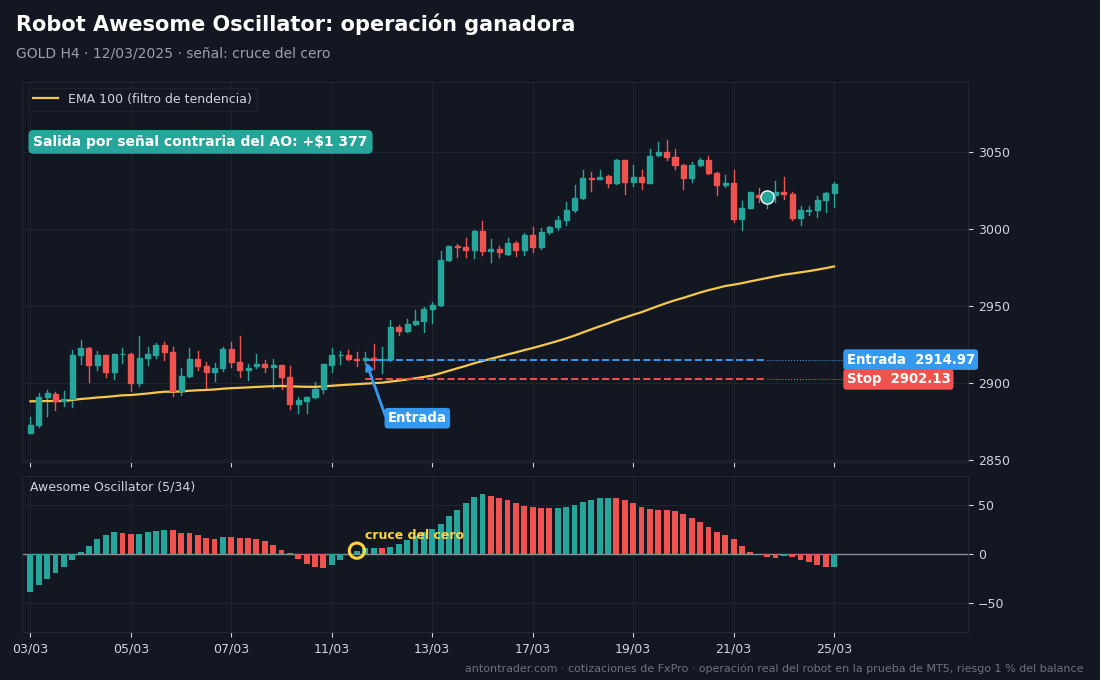
Winning trade. On March 12, 2025, gold was above the EMA 100, and the AO histogram, after a brief dip below zero, turned positive again. The robot bought at 2914.97 with a stop at 2902.13, just one ATR. The price then rose for 12 days, and the robot didn’t close the trade until March 24, when the AO dropped below zero: exit near 3020, +$1,377. One trade like that covers eight stops.
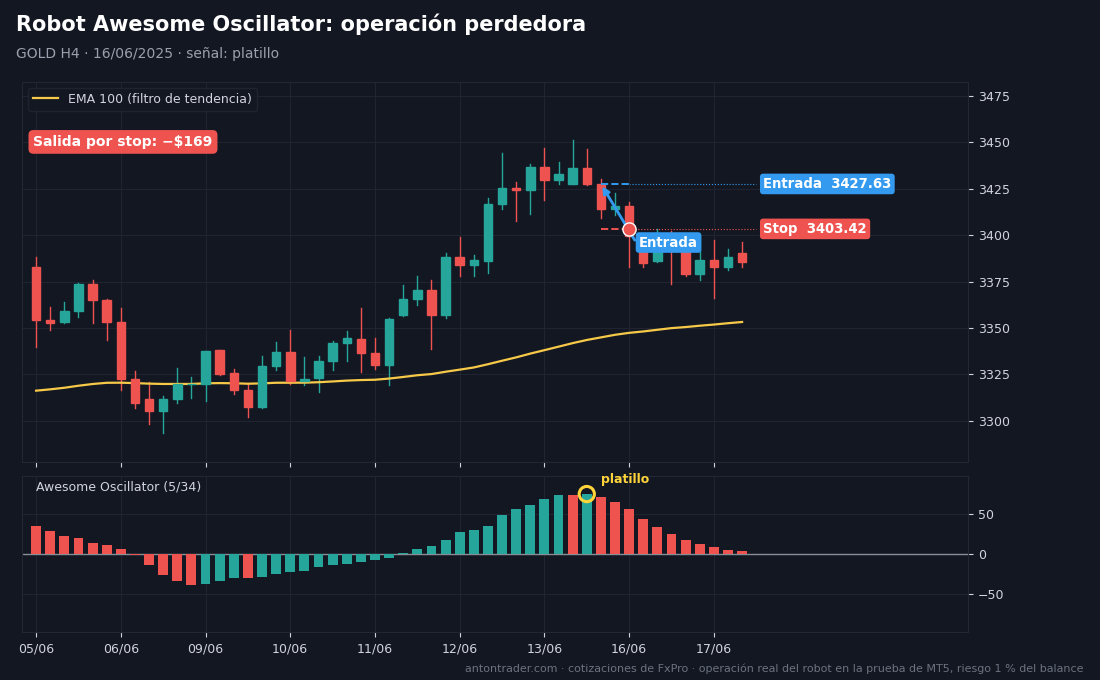
Losing trade. On June 16, 2025, at the top of the rally, the histogram printed a “saucer”: one bar down and the next one up. The robot bought at 3427.63, with a stop at 3403.42. But that momentum was the last of the move: the same day gold reversed and hit the stop: −$169, exactly 1% of the balance. Most of the robot’s trades look like this, and it’s its normal job: the loss is small and known in advance.
Here’s how to do it manually: open gold on H4 and add the standard Awesome Oscillator indicator and an EMA 100. Buy at the open of the next candle if the candle closed above the EMA 100 and the AO crossed zero upward or drew a “saucer” above zero. Place the stop one ATR(14) from the entry. Close the trade when the AO crosses zero downward or draws a “saucer” below zero. Don’t open sells.
Robot results: training and forward test
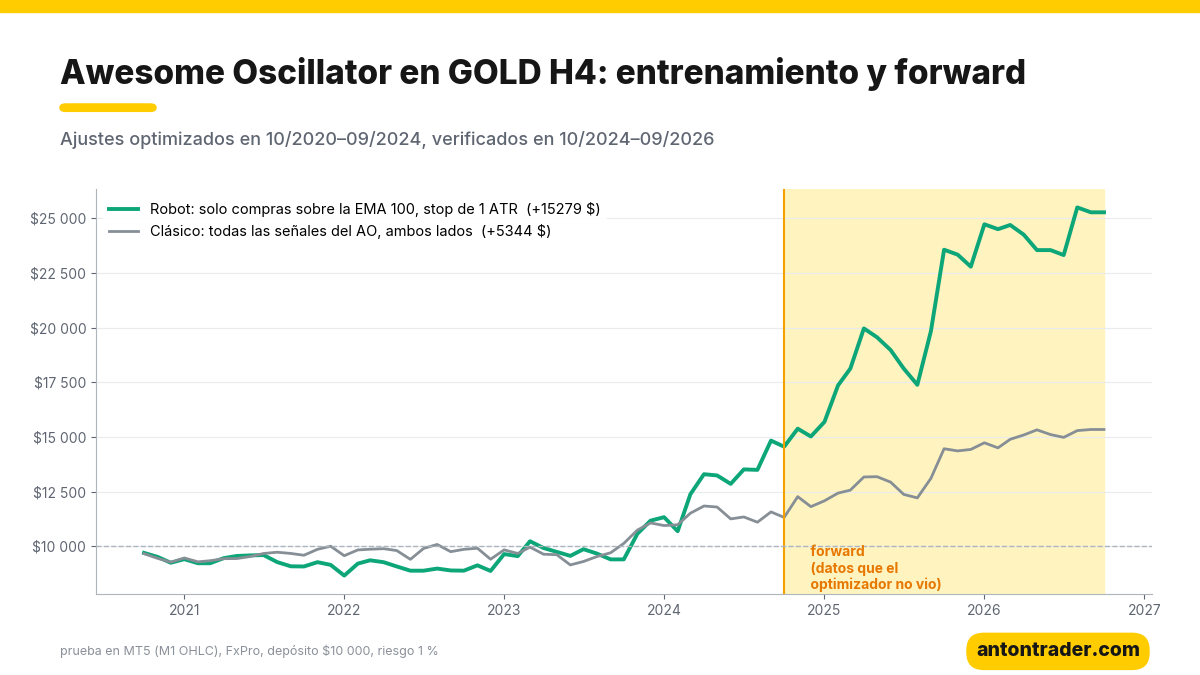
To avoid fooling myself with overfitting, I split the history into two parts. The parameters are chosen only on 10/2020–09/2024. Then the robot takes its exam on 10/2024–09/2026, data the optimizer didn’t see. The test: MetaTrader 5 strategy tester, FxPro demo account with its quotes, spreads, commissions and swaps, $10,000 deposit, 1:500 leverage, “1 minute OHLC” mode, 72 months.
| Period (GOLD H4) | Return | Profit factor | Max drawdown | Trades |
|---|---|---|---|---|
| Training, 10/2020–09/2024 | +48.4% | 1.57 | 17.3% | 115 |
| Forward, 10/2024–09/2026 | +70.0% | 2.31 | 18.1% | 58 |
| Full 72 months, 1% risk | +152.8% | 1.91 | 18.5% | 173 |
| Full 72 months, 2% risk | +448.2% | 1.92 | 33.5% | 173 |
| Longest stretch without a new high | ≈ 29 months (10/2020–03/2023) |
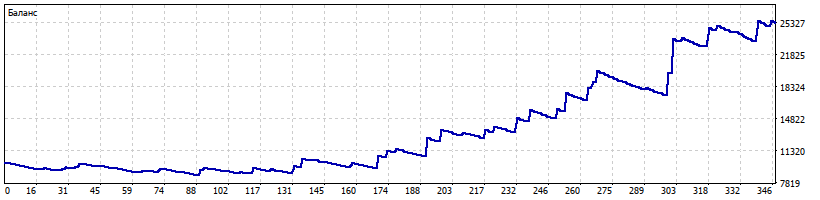
On unseen data the profit factor didn’t fall; it rose, from 1.57 to 2.31. And it isn’t a single lucky combination of numbers: of 102 profitable parameter sets in training, 98 also made money in the forward test. Neighboring parameters behave the same way: a 1.5 ATR stop instead of 1 ATR gave +40.9% in the forward test with a profit factor of 2.27, and an EMA 150 or EMA 200 filter instead of EMA 100 gave +61.9% and +65.3%. But let me tell you where these numbers come from: the robot makes money from gold’s trends, and over the last three years gold has risen almost without pause. In 2020–2022, when gold moved in a range, the robot ended every year with a small loss. Speaking plainly about the money: commissions took only $115 over 72 months, and swaps on gold buys at FxPro took $5,461. Trades last days and weeks, and that costs money.
📊 Download the robot and the parameters for gold H4
Why the “internet” Awesome Oscillator doesn’t work and this robot does
First I ran the strategy the way it’s usually described: daily chart, Williams’ two signals (zero-line cross and “saucer”), buys and sells, exit on the opposite signal, and a protective 2 ATR stop. Seven markets, 72 months:
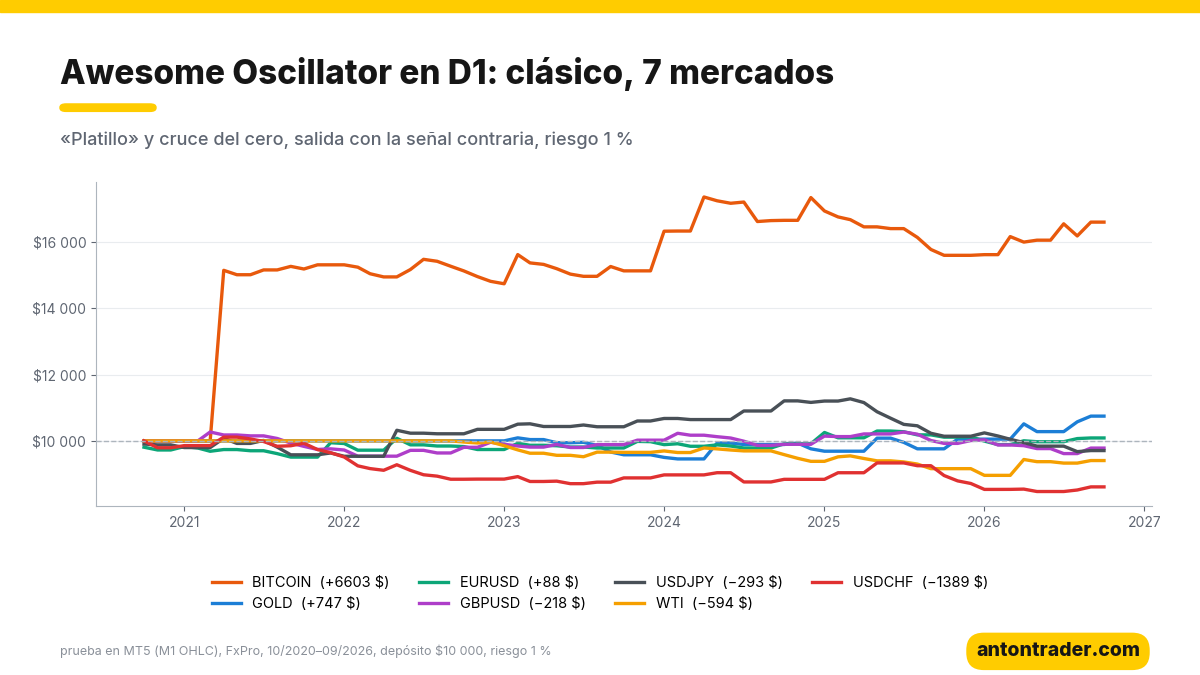
| Instrument (D1) | Result | Profit factor | Max drawdown | Trades |
|---|---|---|---|---|
| BITCOIN | +66.0% | 1.94 | 14.5% | 86 |
| GOLD | +7.5% | 1.38 | 13.4% | 41 |
| EURUSD | +0.9% | 1.03 | 6.9% | 56 |
| GBPUSD | −2.2% | 0.92 | 9.2% | 60 |
| USDJPY | −2.9% | 0.92 | 16.8% | 70 |
| WTI (oil) | −5.9% | 0.70 | 11.5% | 51 |
| USDCHF | −13.9% | 0.63 | 18.6% | 76 |
Four markets out of seven end up negative, and bitcoin’s big positive result came almost entirely from a single trade in early 2021; on the chart it shows up as one single step. There are three reasons:
- Counter-trend sells. In a bull market, a downward zero cross is almost always a normal pullback, not a reversal. The classic version sells every one of those pullbacks and piles up stops.
- A stop that’s too wide on D1. Two daily ATRs is a lot of distance: the lot size ends up small and a losing trade stays open for weeks. The long losers eat the profit from the few trends.
- Swaps. Trades with daily signals last weeks: on bitcoin, swaps took $3,246 over six years, and on the other markets, $360 to $800.
The robot that works differs in exactly that: H4 instead of D1, more signals; a short one-ATR stop; buys only, and only above the EMA 100. For comparison: the same classic version on gold H4, with sells and a 2 ATR stop, returned +53.4% in 72 months with a profit factor of 1.33, three times less than the robot. The robot is tuned only for gold H4, and I don’t advise moving it to other markets without your own test.
The risks, plainly
- The robot makes money from gold’s trends. From October 2020 to March 2023, about 29 months, the balance didn’t set a new high. The entire result comes from the 2023–2026 rally. If gold enters a long range or a decline, the robot will spend months going nowhere or losing. Prepare for that before you start it, not after.
- Three out of four trades are stops. 26% of trades close in profit. The longest streak: 10 stops in a row in May–July 2025, around −$1,922. Psychologically it’s heavy, even if the robot ends up in the green.
- Swaps. Over 72 months they took $5,461, about a quarter of the profit before costs. With a broker that charges higher swaps on gold, the result will be worse.
- 2% risk almost doubles the drawdown: 33.5% instead of 18.5%. I would start with 0.5–1% and raise the risk only after the robot has worked for you live.
Where to run it
The robot works on MetaTrader 5 with any broker that offers gold (XAUUSD or GOLD). My test was done at FxPro. The other brokers in my ranking also work: RoboForex and Tickmill. Before putting the robot on an account, run it in your broker’s tester: it takes an afternoon and shows you how it behaves with your quotes, spreads and swaps. For it to work continuously, keep the platform on a VPS: the robot checks for a signal at the close of each H4 candle, and if the platform is off, the entry or the exit is missed.
Download the Awesome Oscillator robot for free
The robot is free for clients of the brokers in my ranking:
- Open a MetaTrader 5 account with one of the brokers above (or use the one you already have).
- Go to the Telegram bot with the button and send your account number.
- After verification, the bot sends you the file: the robot, the parameters for gold H4, Williams’ classic parameters for your own experiments, and the instructions.
📊 Download the robot for free on Telegram
My conclusion
The Awesome Oscillator in its classic form is a pretty indicator, but it has no edge: on the daily chart it barely moved forward in six years, and bitcoin’s notable positive result came from a single trade. If you keep the same two Williams signals, but trade gold on H4, buy only above the EMA 100, and use a short stop, you get a robot that multiplied the deposit by 2.5 in 72 months and made 70% in two unseen years with a profit factor of 2.31. The forward test confirmed it, and the neighboring parameters behaved the same way. But remember what you pay for this return with: long periods without growth when gold has no trend, and streaks of stops. Protect your deposit: start with 0.5–1% risk.
Today I also analyzed Lambert’s CCI, a robot for USDJPY with a smoother curve. On gold, Heikin-Ashi, Raschke’s “80-20” and TTM Squeeze also passed the test. From the same Williams system: fractals (a robot for USDJPY) and the Alligator.
Why 72 months?
The market changes fundamentally every 3–5 years: participants and volatility change, and trends give way to ranges. That’s why I don’t run 10–20 year tests: they blend different markets into a single average figure. This robot is a good example. In 2021–2022 gold moved in a wide range, and the robot sat still. In 2023 a strong trend began, and the same robot, with the same parameters, started making money. A strategy has to be chosen for the current market and changed when the market changes, and that applies to this robot too: if gold’s trend ends, it should be stopped.
That’s why I built my app “Find your strategy”, in the browser or on Telegram. There you can test any idea on up to 72 months of history, and every 2 weeks the app automatically runs tens of thousands of strategies and shows you the ones that work over the last 6, 12 and 36 months. It doesn’t promise profits: it helps you notice in time that the market has changed.
Backtest results do not guarantee future results.
Sources
- Bill Williams: “New Trading Dimensions: How to Profit from Chaos in Stocks, Bonds, and Commodities” (Wiley, 1998), the Awesome Oscillator and the “zero-line cross” and “saucer” signals.
- Bill Williams, Justine Gregory-Williams: “Trading Chaos: Maximize Profits with Proven Technical Techniques,” 2nd edition (Wiley, 2004), the Awesome Oscillator within Williams’ system.
- My own tests in MetaTrader 5 on the FxPro demo server, November 2026.
Where to trade
These are the brokers and exchanges I use that work with clients from Latin America. Always check that the service is available in your country, and start small.
Risk warning: CFDs, Forex and crypto derivatives carry a high risk of losing money due to leverage. This article is not investment advice.